

From the G7 Hiroshima AI Process to Verifiable AI Governance: A Japan-Led Vision for International Standards
From the G7 Hiroshima AI Process to Verifiable AI Governance: A Japan-Led Vision for International Standards

Main points of discussion on the day
Event overview
TOKYO, JAPAN, October 28, 2026 /EINPresswire.com/ -- Introducing a vision for connecting logistics decisions across differences among companies and AI systems, and publicly available technology that verifies whether AI proposals may be executed. The conference’s message collection and practical guide are now available in Japanese and English.
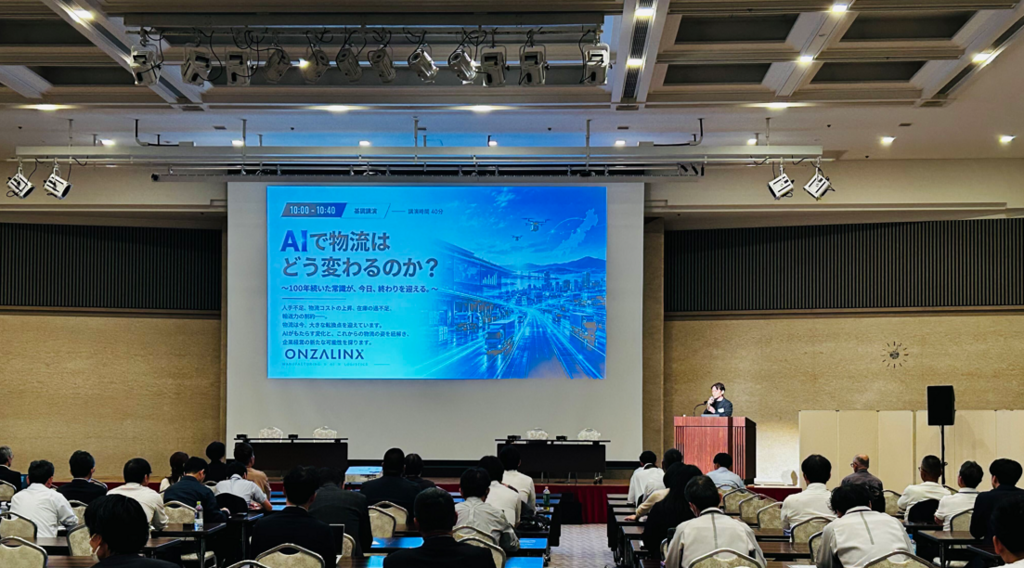
ONZALINX Co., Ltd. (Representative Director: Masaya Higashi) held the “Manufacturing AI Logistics Conference 2026 in Hiroshima” on October 14, 2026, at the International Conference Center Hiroshima. Speakers from the Ministry of Internal Affairs and Communications, Hiroshima Prefecture, manufacturing, logistics and IT companies, and other organizations discussed the use of AI, intercompany collaboration in logistics, and ensuring reliability in actual operations. [1]
What our company and the Hiroshima AI Assurance Council (hereinafter “HAAC”) aim to achieve is to develop the principles of the G7 Hiroshima AI Process, whose launch was led by Japan, into technical standards for AI governance that can be used in common around the world. In addition to responding to overseas regulatory frameworks, we seek to propose verifiable common mechanisms from Japan. To this end, we will communicate the discussions at the conference and practical knowledge from various fields in Japanese and English, while also introducing publicly available technology expanded by AI Assurance, Inc. in preparation for the conference, connecting the “Hiroshima AI Process” with some of the technical requirements of Europe’s AI regulatory law, the “EU AI Act.” [2][3] [5]
Background to the Conference | Thinking About Logistics Beyond Company Boundaries
Challenges in logistics, including labor shortages, constraints on transportation capacity, rising costs, and excesses or shortages of inventory, are becoming difficult to resolve through improvements by a single company alone. Under the theme “Designing Logistics as a Management OS,” the conference discussed the potential to connect inventory, transportation, and on-site data with decision-making. Beyond this lies “HIROSHIMA FLOW,” advocated by our company, and the concept of a “Verifiable Physical Internet,” which we jointly advocate with AI Assurance. We aim for a future in which companies can coordinate and verify decisions on collaborative logistics while maintaining their different management objectives and existing systems, without sharing more confidential information than necessary. [8][9]
The conference also highlighted a Japan-origin initiative to advance the development of a verifiable Physical Internet.
A dedicated panel brought together representatives from Japan’s Ministry of Economy, Trade and Industry (METI), Ministry of Land, Infrastructure, Transport and Tourism (MLIT), Mazda, and Eikei University to discuss Hiroshima’s potential as a Physical Internet testbed.
Beyond data connectivity and logistics optimization, ONZALINX and AI Assurance’s proposed “Verifiable Physical Internet” seeks to address a fundamental challenge: enabling companies with different objectives and systems to independently verify whether joint logistics decisions meet the conditions for adoption and execution, without requiring them to directly share detailed operational data.
The architecture combines three elements—Logistics Decision Packets, Beacon, and an AI assurance layer. Four related PCT international patent applications have been filed, and structural conditions for verifiable scalability have been formalized in Lean 4 under explicitly stated assumptions and made publicly available. [1][8]
Main Points of Discussion on the Day
Intercompany Collaboration: How can logistics-wide efficiency and consensus-building be reconciled while taking account of each company's objectives and constraints?
Management and Operations: How should issues such as waiting times and data quality be addressed not only as operational improvements but also as management decisions?
AI Reliability: How should the distinction between AI proposals and decisions to execute them be designed, including verification of necessary conditions and evidence and identification of situations where human involvement is required?
Central Theme to Communicate Overseas | AI “Proposals” and “Execution” Are Different
Even when AI produces a useful proposal, it does not necessarily mean that the proposal may be executed as-is in actual operations. In logistics, for example, there are conditions that must be satisfied, including not only delivery deadlines but also quality, safety, the authority of the person in charge, and contracts. It is important to determine the scope entrusted to AI, to hold execution when conditions are not met, and to establish mechanisms that allow the grounds for decisions to be checked afterward.
HAAC aims to translate this approach from the principles of the Hiroshima AI Process into items to be checked in actual operations, and to connect them to mechanisms that can be verified across national and organizational boundaries. [2][4]
Related Technical Outcomes | Technically Connecting the Hiroshima AI Process and the EU AI Act
The Hiroshima AI Process is an international AI governance initiative advanced following the G7 Hiroshima Summit in 2023. The EU AI Act, meanwhile, is a European law regulating AI. This technical research does not treat the two as the same regulatory framework, but distinguishes between conditions that can be checked in common and conditions that must be checked separately. [3][5]
Building on the “Responsibility OS” it has been developing, AI Assurance, Inc. expanded a publicly available technical foundation that maps the principles of the Hiroshima AI Process to selected technical requirements from the EU AI Act. Its distinctive feature is that it does more than show the correspondence between regulatory frameworks: it distinguishes conditions and evidence that can be carried over from matters requiring additional verification, and verifies a mechanism that holds adoption and execution within a reference implementation if the required conditions are missing. The formal model was checked in Lean 4, and the reference implementation was tested against a fixed version of a publicly available logistics proof of concept (PoC), including checks that concrete PoC results correspond to the formal model. The source code and verification procedures are publicly available.[3]
① AI Makes a Proposal
The logistics PoC determines that it is “Adoptable”
② Verify Conditions
Hold if required documents, monitoring plans, etc., are missing
③ Record and Recheck
Save the required conditions and the grounds for the determination
For example, in connection verification for a pharmaceutical cold chain, even if the original logistics PoC determines “RELEASE (adoptable),” the process is held if the documents or monitoring plans required at the connection destination are not in place. Only when the conditions are met does the process proceed to adoption within the reference implementation. This is a technical reference example demonstrating that, even when regulatory frameworks change, execution does not proceed unconditionally on the basis of a previous evaluation alone. [3]
In the publicly available automated verification conducted on October 10, 2026, Lean4 proof checking, 18 Python tests, connection to a fixed version of the logistics PoC, and comparison against execution results were all successful. The verification code and procedures have been published so that third parties can check them under the same assumptions. [3]
※ These results do not prove legal compliance with the EU AI Act as a whole, official certification, or the safety of an entire real-world system. They are research and technical results that check selected technical requirements under explicitly stated assumptions.
Two Publication Outcomes Emerging from the Conference
① AI HIROSHIMA Messages | Sharing Practical Knowledge from Different Perspectives in Japanese and English
Messages contributed from diverse perspectives, including logistics, IT, investment, and government, have been published as a collection of contributions. We will convey perspectives relevant to on-the-ground practice, including the scope entrusted to AI, the conditions under which humans make decisions, where responsibility lies, and the formation of trust among companies, to audiences in Japan and overseas. Each contribution represents the views of its author and does not constitute a joint proposal or an endorsement of any particular technology.
② Hiroshima AI Logistics Practical Guide 2026 | A Checklist for Companies to Get Started
This is a general-audience resource edited and published by ONZALINX, with technical cooperation from AI Assurance. It sets out six practical starting points—purpose and scope, adoption conditions, roles and authority, data and evidence, exception handling, and records and reverification—alongside an implementation roadmap, an audit checklist, and record templates.
The guide helps executives and on-site personnel identify gaps and plan next steps. [1]
※ The guide and checklist are materials intended to support preparation for introduction and operation; they do not indicate legal compliance, safety certification, or authorization for production operations.
Separately Published Verification Results | AI Proposals Are Not Executed Unconditionally
Based on a pharmaceutical cold-chain PoC jointly developed by ONZALINX and AI Assurance, AI Assurance conducted additional experiments using the OpenAI API. Across 30 recorded live API requests—six pilot requests and 24 standard-test requests—no RELEASE proposal violated the PoC’s predefined release conditions. In a separate, API-free test of 24 cases, RELEASE requests were deliberately generated for every case. The independent gate blocked the 19 requests that failed those conditions and permitted simulated handoffs for the five that satisfied them. The results and records for reverification have been published. [7]
※ Because no noncompliant RELEASE proposals arose in the live API runs, the gate’s incremental blocking effect could not be estimated from those runs. The experiments used synthetic data; no actual shipment or equipment control was performed. These results are separate from the formal verification concerning the connection with the EU AI Act.
Future Developments | Bringing Verifiable Mechanisms into Real-World Use Worldwide
HAAC will use the practical knowledge from the conference and the related technical verification to develop a proposed common protocol, the “Hiroshima AI Assurance Protocol (HAAP).” We aim to create a mechanism through which the adoption and execution conditions, evidence, responsibility, and verification results associated with AI decisions can be checked in a common way, even across different countries, companies, and AI systems. Starting with manufacturing and logistics, we will also consider applications to AI agents, physical AI, and other areas, developing HAAP into a technical standard that can be used around the world and thereby contributing to the international standardization of AI governance originating in Japan. [4]
HAAC’s objective is not to impose uniform AI safety rules, but to establish a common way to independently verify the grounds for AI safety claims. The Hiroshima AI Process itself recognizes that countries may implement its principles differently. [11]
Formal verification provides the mathematical basis. Put simply, it shifts the question from “Who says this AI system is safe?” to “What, exactly, has been proved?” Under explicit assumptions and shared logical rules, proofs can be checked independently of their authors. Within a defined model, decision rules can also be proved complete and non-conflicting for a specified set of cases. [12][13] Whether those assumptions and rules are appropriate for a particular use remains a separate question.
HAAP aims to connect such proofs with testing and real-world evidence, clarifying what is established, under which conditions, and what remains unverified.
In short, even when countries have different AI safety rules, formal verification enables precisely defined safety claims to be checked through a common, independent method, under explicit assumptions and independently of the proof’s author.
HAAC is a private, independent council and participates in the “Partners’ Community” of the Hiroshima AI Process Friends Group. However, this participation does not mean that any particular technology has been approved, certified, or endorsed by the G7, the Japanese government, the OECD, or other such bodies. HAAP is a proposal under development and has not been established as a formal common specification. [2][4]
ONZALINX and HAAC welcome reviews of the publicly available technology and proposals for joint demonstrations from researchers, evaluation bodies, companies, and standardization stakeholders in Japan and overseas. “Toward making Japan a society where AI can be used with the greatest peace of mind in the world.” With the aim of realizing this vision, we will connect the practical knowledge and verifiable technologies gained in Hiroshima to ongoing joint demonstrations and real-world implementation in Japan and overseas, starting with logistics. [6]
Event Overview and Communications Structure
Event Overview
Event name: Manufacturing AI Logistics Conference 2026 in Hiroshima
Date and venue: Wednesday, October 14, 2026 / International Conference Center Hiroshima (Naka Ward, Hiroshima City) and online
Theme: Designing Logistics as a Management OS
Organizer: ONZALINX Co., Ltd. Planning cooperation: Hiroshima AI Assurance Council
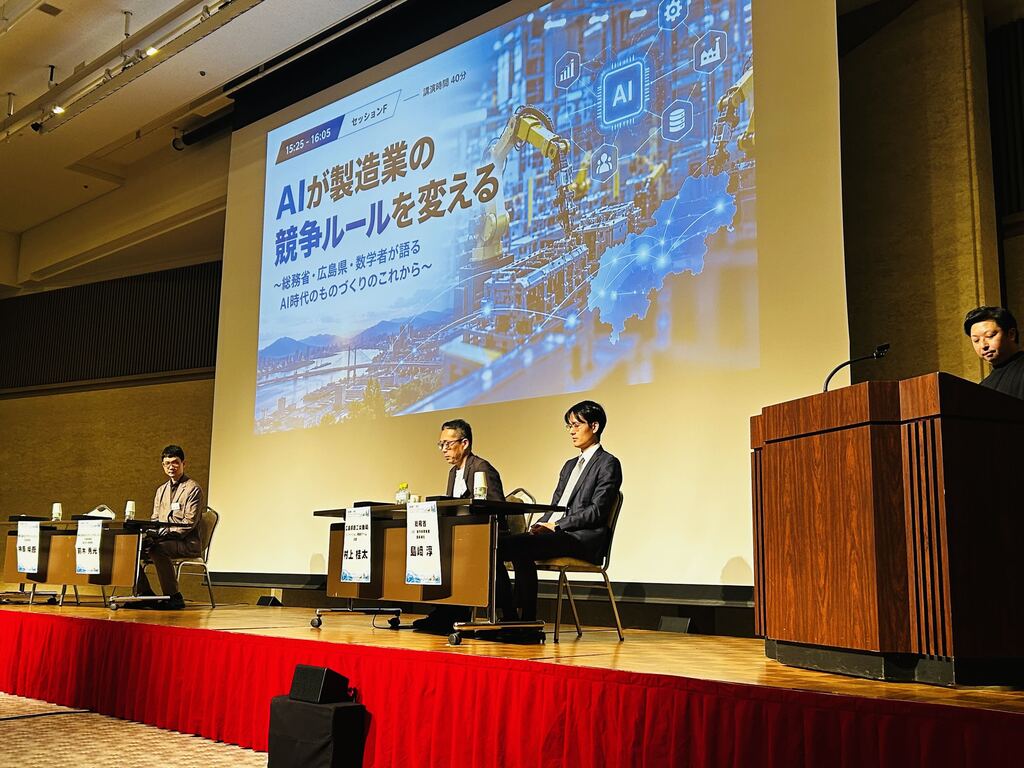
※ A detailed report (in English) on Session F, “AI Is Changing the Rules of Competition in Manufacturing,” which featured speakers from the Ministry of Internal Affairs and Communications, Hiroshima Prefecture, and AI Assurance and discussed trends in international AI governance, Hiroshima Prefecture's support for demonstration projects, the real-world implementation of technology by the private sector, and other topics, has been published on HAAC Media. [10]
Roles of Each Organization
ONZALINX Co., Ltd.: Conference organizer; editor and publisher of the practical guide.
Hiroshima AI Assurance Council (HAAC): Planning cooperation; communication of practical knowledge and verifiable mechanisms.
AI Assurance, Inc.: Technology development and cooperation relating to Responsibility OS, the Lean4 technical foundation, additional experiments based on the collaborative logistics PoC, and other activities.
Publicly Available Materials and Inquiries
[1] Official conference information and announcements of the release of materials in Japanese and English
https://www.onzalinx.co.jp/conference2026/
[2] HAAC establishment and activity policy / Participation in the Partners’ Community
https://prtimes.jp/main/html/rd/p/000000015.000169775.html
[3] Hiroshima AI Process × Responsibility OS × EU AI Act: Publicly Available Technical Foundation (Verification Version a479ee9)
https://github.com/GhostDriftTheory/hiroshima-ai-process-eu-ai-act-bridge
[4] HAAP: Technical Overview of the Proposed Common Protocol
https://hiroshima-ai-assurance.com/protocol
[5] Ministry of Foreign Affairs, “AI Diplomacy”: Hiroshima AI Process
https://www.mofa.go.jp/mofaj/ecm/st/pagew_000001_01551.html
[6] Inquiries about media coverage, technical reviews, and joint demonstrations
https://hiroshima-ai-assurance.com/contact
[7] Additional OpenAI API Verification Based on the Collaborative Logistics PoC
https://github.com/GhostDriftTheory/coldchain-handoff-assurance
[8] “Verifiable Physical Internet” Concept by ONZALINX and AI Assurance (formerly GhostDrift Mathematical Institute) (announced on September 9, 2026)
https://prtimes.jp/main/html/rd/p/000000014.000169775.html
Related PCT International Patent Applications:
• PCT/JP2026/032318 — Verifying that participating companies are not disadvantaged, that consent and authority are in place, and linking joint plans to execution and settlement.
• PCT/JP2026/032319 — Translating data from different ERP, TMS, and other systems into common decision conditions, linking corrective planning, reservations, and execution.
• PCT/JP2026/032323 — Verifying that operational meaning is preserved when logistics data and instructions are transformed between systems.
• PCT/JP2026/032478 — Enabling verifiable collaborative logistics without requiring companies to directly share detailed operational data.
Lean 4 Formalization:
Structural conditions for scaling the Physical Internet while preserving verifiability have been formalized under explicitly stated assumptions and made publicly available.
https://github.com/GhostDriftTheory/physical-internet-verified-scalability
[9] LOGISTICS TODAY, “ONZALINX Holds AI Logistics Conference in Hiroshima” (introducing the HIROSHIMA FLOW concept)
https://www.logi-today.com/991992
[10] HAAC Media: Detailed Report on Session F, “AI Is Changing the Rules of Competition in Manufacturing” (English, published October 16, 2026)
https://hiroshima-ai-assurance.com/news/quJzpEC7
[11] G7 | Hiroshima Process International Guiding Principles for Organizations Developing Advanced AI Systems (October 30, 2023), p. 1
https://www.mofa.go.jp/files/100573471.pdf
[12] George C. Necula | Proof-Carrying Code
Proceedings of the 24th ACM SIGPLAN-SIGACT Symposium on Principles of Programming Languages (POPL ’97), 1997, pp. 106–119.
https://doi.org/10.1145/263699.263712
[13] Lean | The Lean Language Reference: Validating a Lean Proof
https://lean-lang.org/doc/reference/latest/ValidatingProofs/
Masaya Higashi
ONZALINX Co., Ltd.
higashi@onzalinx.co.jp
Legal Disclaimer:
EIN Presswire provides this news content "as is" without warranty of any kind. We do not accept any responsibility or liability for the accuracy, content, images, videos, licenses, completeness, legality, or reliability of the information contained in this article. If you have any complaints or copyright issues related to this article, kindly contact the author above.
