

Law Office of Justin C. Frankel, P.C. Recognizes September as Blood Cancer Awareness Month
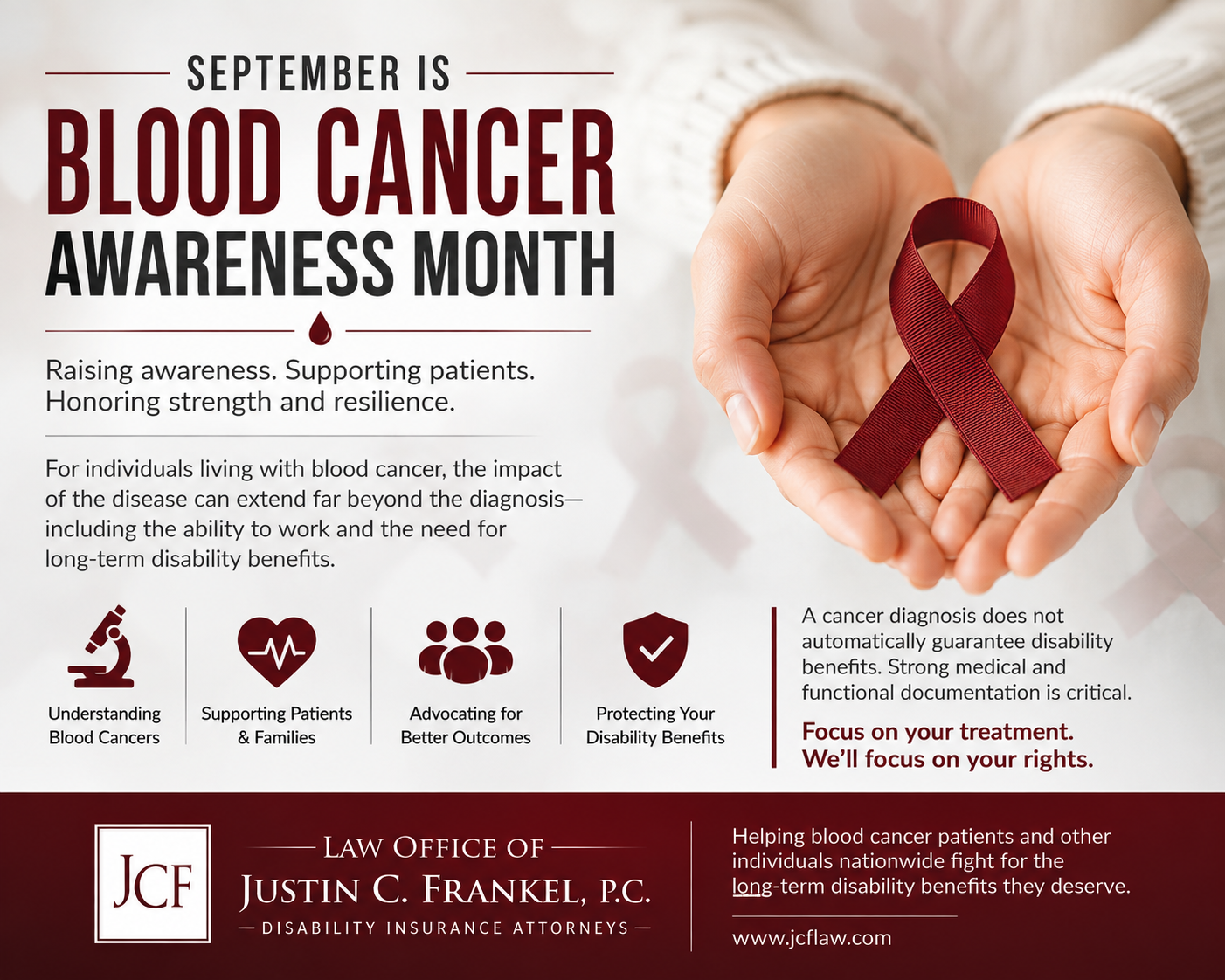
Disability Insurance Attorney Justin C. Frankel Encourages Blood Cancer Patients to Understand and Protect Their Long-Term Disability Benefits
CARLE PLACE, NY, UNITED STATES, September 1, 2026 /EINPresswire.com/ -- Law Office of Justin C. Frankel, P.C. Recognizes September as Blood Cancer Awareness Month and Highlights Long-Term Disability Challenges Facing PatientsDisability Insurance Attorney Justin C. Frankel Encourages Blood Cancer Patients to Understand and Protect Their Long-Term Disability Benefits
The Law Office of Justin C. Frankel, P.C., a national law firm focused on disability insurance claims and litigation, recognizes September as Blood Cancer Awareness Month and joins patients, families, healthcare professionals, advocates, and organizations across the country in raising awareness about leukemia, lymphoma, multiple myeloma, and the many other forms of blood cancer.
September is recognized as Blood Cancer Awareness Month, a time dedicated to increasing understanding of blood cancers and supporting the individuals and families affected by these diseases. Blood Cancer United, formerly known as The Leukemia & Lymphoma Society, is among the organizations leading nationwide awareness and patient-support efforts throughout the month.
For individuals living with blood cancer, however, the impact of the disease can extend far beyond the diagnosis itself. Cancer and its treatment may profoundly affect a person's ability to continue working, particularly in occupations requiring prolonged concentration, physical stamina, consistent attendance, travel, decision-making, or demanding schedules.
“Blood cancer can dramatically change a person's life and ability to work, sometimes virtually overnight,” said Justin C. Frankel, founding attorney of the Law Office of Justin C. Frankel, P.C. “Patients should be able to focus on their treatment and recovery without simultaneously worrying about whether an insurance company will recognize the very real limitations caused by their illness and treatment.”
Blood Cancer and the Ability to Work
Leukemia, lymphoma, multiple myeloma, and other blood cancers can require lengthy and intensive courses of treatment, including chemotherapy, immunotherapy, radiation therapy, targeted therapies, stem-cell transplantation, surgery, or combinations of treatments.
Even when treatment is successful, patients may experience significant ongoing limitations from the disease, the treatment, or both. These can include profound fatigue, weakness, pain, neuropathy, cognitive difficulties, impaired concentration, susceptibility to infection, gastrointestinal complications, sleep disruption, and reduced physical endurance.
For many professionals, these limitations can make returning to a demanding occupation difficult or impossible, even when a person may appear outwardly healthy.
The scale of the problem remains substantial. The American Cancer Society estimates that approximately 67,790 new cases of leukemia will be diagnosed in the United States in 2026. It also estimates approximately 79,320 new cases of non-Hodgkin lymphoma and approximately 36,000 new cases of multiple myeloma this year.
A Cancer Diagnosis Does Not Automatically Guarantee Disability Benefits
One of the most important issues for individuals covered by long-term disability insurance is understanding that a serious diagnosis, standing alone, does not necessarily establish entitlement to disability benefits.
Disability insurance companies typically focus on whether the claimant's medical condition and resulting restrictions prevent that individual from performing the material and substantial duties of his or her occupation as defined by the applicable policy or employee benefit plan.
That distinction can become especially important with blood cancers.
A claimant may have completed chemotherapy or reached remission while continuing to experience debilitating fatigue, cognitive impairment, neuropathy, weakness, treatment complications, or other functional limitations. An insurance company may focus heavily on laboratory results, imaging, remission status, or statements that the disease is “stable,” while giving insufficient consideration to whether the individual actually has the functional capacity to resume the demands of a full-time occupation.
“Being medically stable and being capable of returning to work are two entirely different questions,” Frankel said. “In a disability claim, the focus must be on function. What can the person realistically and reliably do over the course of a full workday and workweek?”
Strong Medical and Functional Documentation Is Critical
The Law Office of Justin C. Frankel, P.C. encourages individuals pursuing long-term disability benefits to make certain their medical records accurately document not only their diagnosis and treatment, but also the symptoms and functional limitations preventing them from working.
Depending upon the claim, important evidence may include oncology and hematology records, treatment histories, laboratory findings, imaging, medication side effects, hospitalization records, physician assessments of restrictions and limitations, occupational requirements, and evidence demonstrating the effect of the disease and treatment on the claimant's ability to function consistently.
This documentation can become particularly important when an insurer conducts its own medical review, requests an independent medical examination, questions whether restrictions remain necessary, or attempts to terminate benefits after a period of improvement or remission.
Employees whose disability coverage is provided through an employer may also be subject to the Employee Retirement Income Security Act of 1974 (ERISA). ERISA disability claims involve strict deadlines and procedural requirements, and the administrative appeal can be especially important because the evidence developed during that process may become the record reviewed by a court if litigation is later necessary.
Supporting the Blood Cancer Community
Blood Cancer Awareness Month is also an opportunity to recognize the tremendous progress that has been made in research and treatment. Advances have allowed many people diagnosed with blood cancers to survive longer and, in some cases, live with their disease as a chronic condition. Blood Cancer United notes that progress in research and treatment has enabled some blood cancers to be cured and others to be managed over the long term.
“During Blood Cancer Awareness Month, we honor the patients who are fighting these diseases, the survivors who continue to deal with their lasting effects, the families and caregivers supporting them, and the physicians and researchers working toward better treatments and cures,” Frankel said.
“For individuals whose blood cancer prevents them from continuing their careers, long-term disability insurance can provide an essential financial lifeline. Those benefits should be evaluated based upon the realities of the person's medical condition, treatment, occupation, and functional capacity—not simply the name of the diagnosis or whether a laboratory result has improved.”
Justin C Frankel
Law Office of Justin C. Frankel, P.C.
+1 516-222-1600
jcf@jfrankellaw.com
Visit us on social media:
LinkedIn
Facebook
X
Legal Disclaimer:
EIN Presswire provides this news content "as is" without warranty of any kind. We do not accept any responsibility or liability for the accuracy, content, images, videos, licenses, completeness, legality, or reliability of the information contained in this article. If you have any complaints or copyright issues related to this article, kindly contact the author above.
