

Six Millennium Problems, One Claimed Quantum Route: SBT Offers a Theory of Why
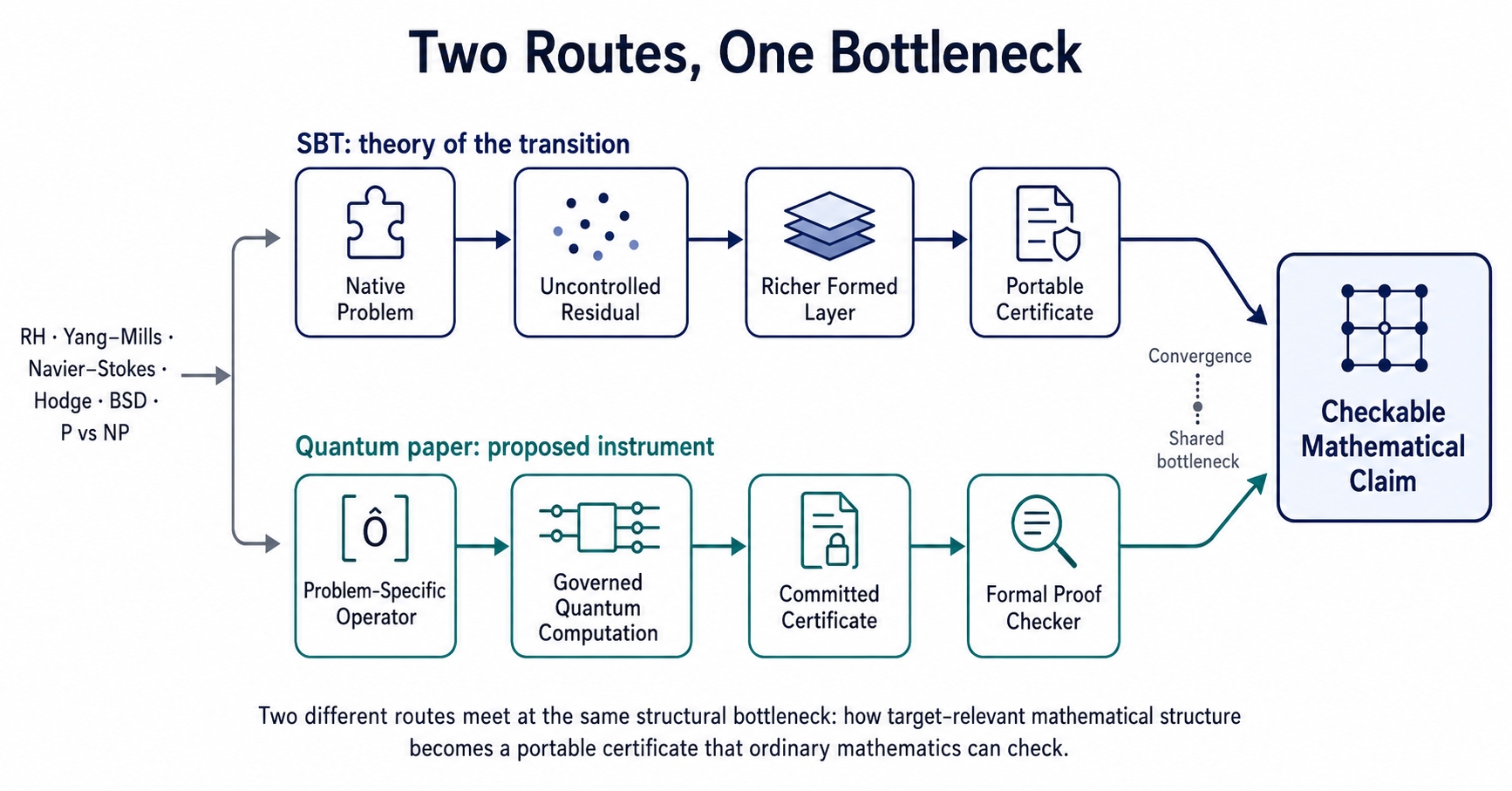
Six Birds Theory and the quantum preprint approach the same structural bottleneck from different directions: one explains the transition, the other proposes an instrument for reaching a checkable mathematical claim.
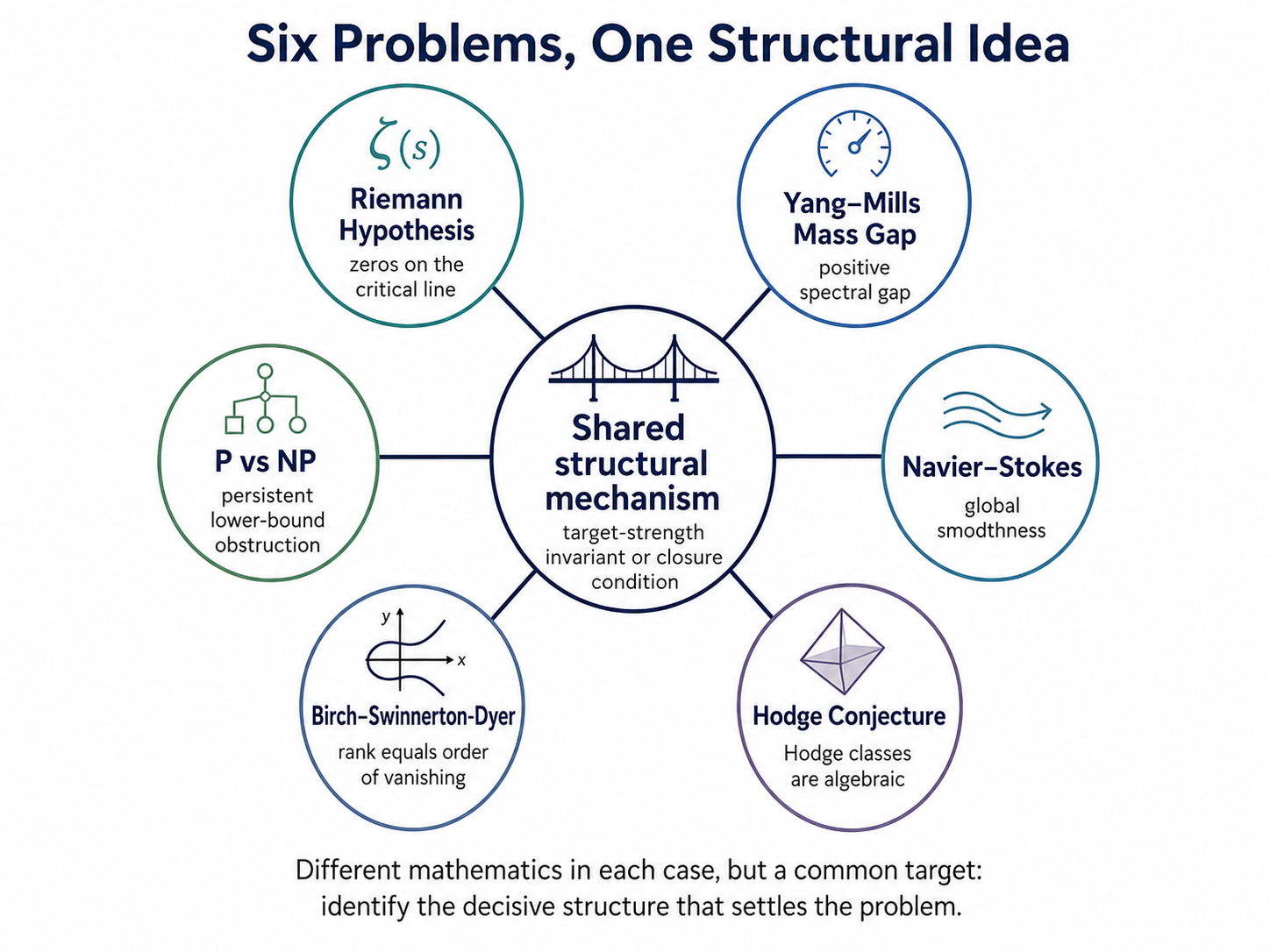
Six mathematically different Millennium Problems can be viewed through one structural question: what decisive invariant or condition is strong enough to settle the target?

The Hodge defect measures the part of the Hodge-class space not accounted for by algebraic cycles, matching the structural role of an SBT adequacy residual.
Earlier Six Birds Theory research offers context for why a richer operational layer could turn inaccessible structure into checkable proof.
The new paper, Demonstrating Quantum Value by Solving the Six Remaining Clay Millennium Problems, by Denise Holt and Denis Ovseyenko of AIX Global, makes an extraordinary claim: that governed quantum computations on IBM Heron processors supplied the decisive content needed to resolve the Riemann Hypothesis, Yang-Mills existence and mass gap, Navier-Stokes regularity, the Hodge Conjecture, the Birch-Swinnerton-Dyer Conjecture, and P versus NP.
The authors report one repeated pipeline: construct a problem-specific operator, perform a governed spectral computation, obtain a committed certificate, and carry that certificate into Lean 4 for formal verification. They report 27 formal theorems, 10 hours and 24 minutes of QPU time, and approximately $59,900 in hardware cost. The paper says that each problem uses a different mathematical operator and deciding invariant, while the computational and certification process remains substantially the same.
The six problems are each associated with a $1 million Clay Mathematics Institute prize. Claims of this magnitude require the scrutiny appropriate to major mathematical results, and the Clay Mathematics Institute continues to list the six problems as unsolved.
More Than a Shared Spectral Idea
The immediate headline is quantum computing. The deeper story may be convergence.
On June 17, more than two months before the AIX preprint dated August 30, Tsiokos published One Meta-Theory, Three Clay-Problem Closures. That paper did not argue that Navier-Stokes, the Riemann Hypothesis, and P versus NP have one mathematical proof. Instead, it argued that they exhibit a recurring structural grammar.
In that grammar, a mathematical target is approached through a particular carrier or presentation. That carrier leaves some target-relevant obstruction unresolved. Additional mathematical content must enter somewhere. A bridge must then carry the result to the actual target, and an audit must distinguish what was internally derived from what had to be supplied from elsewhere.
The paper's Clay-related conclusions are explicitly conditional under the Six Birds closure assumption. They are not presented as unconditional settlements under standard mathematical foundations.
"The quantum paper proposes the instrument. Six Birds Theory offers a theory of why an instrument of that kind could matter," said Ioannis Tsiokos, author of SBT and a researcher at Automorph Inc. "The common mechanism is not one equation. It is one passage - from structure a problem's native language cannot adequately control, to a richer layer that can expose or constrain it, and back to a portable proof certificate."
The two research programs approached this possibility from opposite directions.
SBT began with a general theory of how stable descriptive layers form, what they can lawfully observe, what happens when their existing operations become saturated, and how useful consequences can cross from a richer layer into a more limited one.
The AIX paper says it began with the six problems separately and arrived at one repeated operational sequence: identify a decisive invariant, represent it through an appropriate operator, compute it under governed quantum dynamics, and deliver the resulting certificate to a classical proof checker.
They do not offer the same proof. They identify the same kind of bottleneck.
The Deeper SBT Claim: Hardness Can Be Relative to a Layer
In Six Birds Theory, a mathematical theory is not merely a collection of statements. It can be studied as a stable system of descriptions, operations, observations, and admissible transformations.
One of SBT's foundational distinctions is between completing work inside an existing layer and forming a strict extension of that layer. Once the available structure has become saturated, repeating the same kind of internal completion does not automatically create a genuinely new form of access. A strict extension changes what can be distinguished, represented, measured, or operated upon.
This does not mean a mathematical problem is impossible inside classical mathematics, nor that more classical reasoning can never help. It means that limits can be relative to a specified representation and its permitted operations.
A problem may be perfectly well defined while the particular structure needed to settle it remains unavailable or uncontrolled in the presentation currently being used.
SBT's adequacy work makes this idea more precise. Adequacy Residuals and Blind-Spot Currency defines a positive residual that represents the part of a target-facing quantity not explained by the probes already available to a mathematical carrier.
Adding more information does not automatically solve the problem. A new probe helps only if it captures target-relevant structure that the existing probes miss. Redundant detail can leave the residual unchanged.
When the relevant residual vanishes, the target quantity is fully accounted for by the available structure.
This perspective also helps explain why spectra, kernels, gaps, traces, and positive operators can appear across very different mathematical domains. Positive obstructions cannot disappear through cancellation. A vanishing trace can force a positive residual to vanish. A positive spectral gap can exclude prohibited states. A sufficiently strong global bound can rule out an entire family of counterexamples without checking them one by one.
The visible spectral connection may therefore be only the tip of the iceberg. The deeper question is one of target-relative adequacy: has the chosen structure exposed the decisive distinction, and does the resulting invariant control the entire mathematical target?
Why a Quantum Computer Could Matter
From this perspective, a quantum processor would not be important merely because its state space is large. Its importance would come from creating a different operational layer, with different lawful states, observables, and dynamics from those available to the original problem-solving workflow.
The AIX paper proposes exactly this kind of division of labor. Its private layer is a governed quantum computation. Its public layer is a collection of classical mathematical certificates intended to be checked using Lean 4.
If such an architecture is valid, ordinary mathematics would not need to reconstruct every quantum state or replay the physical discovery process. It would need a sufficient exported certificate whose relationship to the intended theorem can be verified independently.
That asymmetry is central to SBT's account of useful emergence.
A richer supporting structure does not necessarily need to descend in full into the language of the original problem. A smaller consequence formed with its help may cross the boundary and become usable there.
In plain language, the machine would not need to bring the whole hidden structure back. It would need to bring back the part that makes the theorem follow.
This is also why the word "governed" is scientifically interesting.
A stable numerical output is not automatically a theorem. The computation must preserve the mathematical identity of what is being computed, remain within the appropriate admissible sector, survive composition and error, expose an invariant strong enough for the target, and transport that invariant into the exact statement being claimed.
The AIX paper describes compilation, channel-survival, admissibility, and commitment checks at composition barriers.
SBT asks a corresponding structural question: what makes a long physical or computational process count as one lawful operation whose output warrants the conclusion attached to it?
A fixed point and an SBT closure are not the same mathematical object. But the resemblance points toward the same deeper issue. Stopping is not enough. The process must stop at the right object, in the right regime, with the right bridge to the target.
One Grammar, Not One Formula
The six Millennium Problems do not become mathematically identical under this interpretation.
In the Riemann and Yang-Mills cases, the relevant structures are used for forms of confinement or exclusion: zeros must be confined to a line, or physical excitations must remain above a positive gap.
Hodge and Birch-Swinnerton-Dyer compare different presentations of mathematical content: Hodge classes and algebraic cycles in one case, arithmetic rank and analytic order of vanishing in the other.
Navier-Stokes asks for global control strong enough to exclude finite-time breakdown. P versus NP asks whether an obstruction to efficient computation persists against every algorithm in the intended class.
Some closures require an obstruction to vanish. Others require a gap to remain positive, two presentations to agree, a bound to hold globally, or an efficient route to remain impossible.
"One mechanism" therefore does not have to mean one equation or one numerical observable.
It can mean one structural passage: form the right carrier, identify the unresolved load, gain access to a target-strength invariant, and audit the transport from that invariant to the final mathematical conclusion.
Six different problems can share a failure mode without sharing the same mathematics.
A Concrete Mathematical Point of Contact
The Hodge Conjecture provides the clearest exact point of contact between the two programs.
The AIX paper constructs a positive defect operator that measures the portion of the Hodge-class space not accounted for by the algebraic-cycle space. The proposed Hodge closure requires that this defect vanish.
The earlier SBT adequacy paper defines a general residual operator with exactly this structural form: take the target-facing space, remove the part already explained by the native probe space, and measure what remains.
When the SBT construction is specialized so that the target-facing projector is the projector onto Hodge classes and the native projector is the projector onto algebraic-cycle classes, the resulting SBT residual is exactly the Hodge defect operator used in the AIX paper.
This identity does not show that AIX used SBT, and Automorph makes no such allegation. Projection identities are classical mathematics, and the SBT paper expressly does not claim ownership of those mathematical ingredients.
The significance is structural. A concrete operator in the new quantum paper occupies precisely the role that the earlier SBT calculus assigns to a target-relevant residual: the content visible in one presentation that remains unexplained by another.
A Live Scientific Question
Automorph is not presenting this comparison as independent verification of the six claimed resolutions. Nor does the AIX paper transform SBT's conditional Clay papers into unconditional proofs. The two programs differ in mathematics, assumptions, scope, and evidential status.
The interpretation presented here is Automorph's and does not imply AIX Global's endorsement.
The chronology is also specific. The three-problem SBT meta-paper and the adequacy-residual work were public on June 17. The AIX manuscript is dated August 30 and was publicly announced on August 31. Automorph's separate Birch-Swinnerton-Dyer work became public on August 31 and is relevant as later comparative development, not as an earlier-publication claim.
What makes the present moment scientifically interesting is the convergence on a structural possibility.
One research program approached it through a substrate-neutral theory of emergence and closure. Another reports approaching six problems individually and arriving at one governed quantum-to-certificate pipeline.
Whether every proposed operator, universal certificate, limiting argument, and formal target withstands independent review remains to be determined.
But the deeper question can already be asked: can a richer operational layer make a mathematical consequence accessible even when the structure supporting that consequence cannot, or need not, be reconstructed in the language in which the theorem is finally stated?
"The deeper proposition is not that all hard problems are quantum," Tsiokos said. "It is that the route by which a mathematical consequence becomes accessible may be structurally different from the form in which that consequence is ultimately proved."
About Six Birds Theory
Six Birds Theory is a substrate-neutral research program on emergence, closure, and the formation of useful theories. Its work studies stable completions, strict extensions, observational limits, adequacy residuals, confinement mechanisms, inter-theory transport, and audited operational realisability. The program includes foundational papers, formal Lean developments, and applications across mathematics, physics, computation, and biology.
Ioannis Tsiokos
Automorph Inc.
email us here
Legal Disclaimer:
EIN Presswire provides this news content "as is" without warranty of any kind. We do not accept any responsibility or liability for the accuracy, content, images, videos, licenses, completeness, legality, or reliability of the information contained in this article. If you have any complaints or copyright issues related to this article, kindly contact the author above.
