

Doc Hypnosis Highlights Growing Interest in Hypnosis for Stress, Overthinking and Sleep in Phoenix
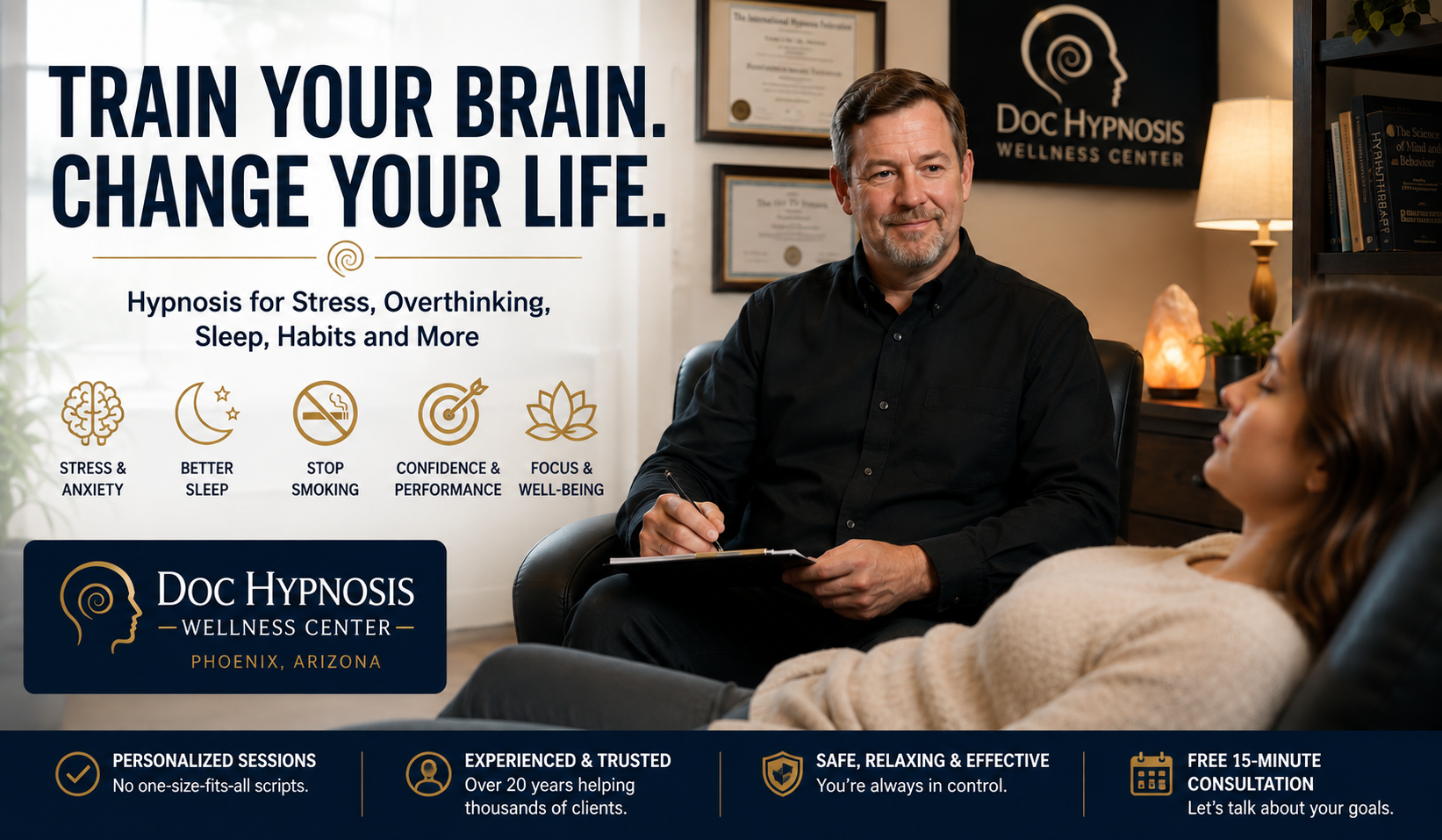
Train Your Brain. Change Your Life.® Doc Hypnosis in Phoenix offers personalized hypnotherapy for stress, overthinking, sleep, unwanted habits, confidence and performance.
As stress, overthinking and sleep struggles rise, Doc Hypnosis explores why more Phoenix residents are turning to hypnosis for change.
Americans are stressed.
They are burned out.
They are tired but can't always sleep.
Their bodies may be sitting on the couch while their minds are still at work.
And increasingly, people are asking a deceptively simple question:
“Why can't I just turn my brain off?”
That question may help explain why nervous-system regulation has emerged as one of the biggest wellness conversations of 2026—and why complementary approaches including hypnosis and hypnotherapy are receiving renewed attention.
The Global Wellness Summit's 2026 Future of Wellness Trends report identified “The Rise of Neurowellness” as a major trend, describing growing interest in regulation, recovery and resilience in response to lives filled with digital stimulation, blurred work boundaries and chronic stress.
The trend is already visible online. The Global Wellness Summit reported approximately 230,000 TikTok videos associated with the hashtag #nervoussystemhealing.
At the same time, workplace stress remains significant.
According to the 2026 NAMI/Ipsos Workplace Mental Health Poll, 53% of surveyed employees reported feeling burned out because of their jobs. Thirty-nine percent said they had felt so overwhelmed that it became difficult to do their work, and 30% described themselves as “very stressed.”
For Dr. William Deihl, a third-generation hypnotist and founder of Doc Hypnosis in Phoenix, Arizona, those numbers reflect something he hears repeatedly from people interested in hypnosis.
“People often come to me already knowing what they want to change,” Deihl said. “They know they want to stop overthinking. They want to sleep. They want to stop smoking, change a habit, become more confident or stop reacting the same way. The problem isn't always knowing what they want. The problem is getting the automatic part of the mind to cooperate with what they consciously want.”
That difference—between knowing what to do and actually doing it—is where Deihl believes hypnosis becomes particularly interesting.
Why Are So Many People Searching for Ways to “Turn Off” Their Minds?
Modern life rarely stops.
Work follows people home through email.
Phones remain within reach almost constantly.
Social media provides an endless stream of stimulation.
News arrives around the clock.
And even when the outside world becomes quiet, the internal conversation may continue.
People describe it in different ways:
“My mind won't shut off.”
“I overthink everything.”
“I keep replaying conversations.”
“I'm exhausted, but I can't relax.”
“I know what I should do, but I keep doing the same thing.”
Those phrases are important because they describe the experience in the same language people frequently use when looking for answers.
Deihl believes the wellness conversation is beginning to shift from simply asking “How can I accomplish more?” toward another question:
“How well can I recover?”
“We have spent years teaching people how to become more productive,” Deihl said. “But high performance without recovery eventually has a cost. Sometimes the skill people need isn't learning how to push harder. It's learning how to disengage from a response when that response is no longer useful.”
What Is Hypnosis?
Despite its portrayal in movies and stage entertainment, hypnosis does not require becoming unconscious or surrendering control of the mind.
Hypnosis generally involves a state of focused attention in which a person may become more absorbed in thoughts, imagery, sensations and suggestions.
A person undergoing hypnosis typically remains aware and involved in the experience.
At Doc Hypnosis in Phoenix, Deihl emphasizes that the process is cooperative.
“I'm not taking control of someone's mind,” he said. “We're working together. Hypnosis is much more interesting when people understand that they participate in the process rather than surrender to it.”
That distinction is especially important for people who are curious about hypnotherapy but nervous about what hypnosis might feel like.
Can Hypnosis Help With Anxiety, Stress and Overthinking?
Research into hypnosis continues to evolve, and responsible practitioners should avoid promising that hypnosis can cure every condition.
The National Center for Complementary and Integrative Health, part of the National Institutes of Health, reports that hypnosis has been studied in connection with several areas, including anxiety associated with medical and dental procedures, pain, irritable bowel syndrome, smoking cessation, menopausal symptoms and other concerns.
Research results vary depending upon the condition and study.
For example, some studies examining hypnosis for anxiety associated with medical or dental procedures have produced promising results, although the overall evidence is not considered conclusive.
Research involving hypnosis and smoking cessation has produced conflicting findings.
There is also a growing body of evidence suggesting hypnosis may be helpful in managing some painful conditions.
For Deihl, acknowledging those limitations strengthens rather than weakens the conversation about hypnosis.
“I don't believe we need to make hypnosis sound magical,” he said. “It is fascinating enough when we explain it accurately. The question is whether hypnosis can help a particular individual work differently with an automatic thought, feeling, behavior or response.”
Hypnotherapy should not replace appropriate medical or mental-health diagnosis and treatment when those services are needed.
Hypnosis and Sleep: What Does the Research Say?
Sleep is another area attracting attention.
A review discussed by the National Center for Complementary and Integrative Health examined studies involving hypnotherapy and sleep. Results were mixed but included studies reporting beneficial effects, particularly among participants experiencing sleep disturbances.
That does not mean hypnosis is a cure for insomnia.
It does suggest another area researchers continue to investigate as interest grows in nonpharmacological and complementary approaches to sleep.
Deihl frequently hears a familiar description from people experiencing difficulty winding down:
“My body is tired, but my brain isn't.”
“Sometimes the harder somebody tries to force themselves to sleep, the more frustrated and alert they become,” Deihl said. “That is one reason learning how to change the relationship with that internal activity can be useful.”
People experiencing persistent sleep difficulties should also speak with an appropriate healthcare professional to rule out underlying medical or sleep disorders.
Why Doesn't Willpower Always Work?
One of the most common misconceptions surrounding behavioral change is that failure to change simply indicates insufficient motivation.
But human behavior is more complicated.
Consider someone who consciously says:
“I don't want to smoke anymore.”
Yet another part of that person's learned response may associate smoking with:
Taking a break
Reducing tension
Driving
Social situations
Finishing a meal
The conscious goal and the learned automatic pattern may therefore conflict.
The same principle can occur with procrastination, confidence, performance, fears and other repetitive behaviors.
Deihl describes hypnosis as one method of exploring that gap.
“If information alone changed behavior, everybody who understood the risks of smoking would immediately stop smoking,” he said. “Human beings aren't machines that simply need more information. We learn associations and responses, and some of those responses become very automatic.”
Why Individualized Hypnotherapy Matters
One of the central philosophies behind Doc Hypnosis Wellness Center in Phoenix is that people should not be treated as though they are identical.
Two people may arrive asking for help with the same behavior for entirely different reasons.
Two people who smoke may have developed the habit under different circumstances.
Two people who describe themselves as anxious may experience completely different triggers.
Two athletes struggling with performance may have completely different internal conversations.
That is why Deihl says he does not approach every client with an identical script.
“I want to understand the person sitting in front of me,” he said. “What happens? When does it happen? What happens immediately before it? What does that pattern seem to accomplish? And most importantly, what does that person want instead?”
The answers can help shape an individualized hypnosis session around the client's particular goals.
Who Searches for Hypnotherapy in Phoenix?
People exploring hypnosis and hypnotherapy do so for many different reasons.
At Doc Hypnosis, people may inquire about hypnosis for goals involving:
Stress and overthinking
Sleep and relaxation
Smoking and vaping cessation
Fears and phobias
Confidence and performance
Others seek help changing unwanted habits or automatic responses that they have struggled to change through conscious effort alone.
Hypnosis may also be used alongside appropriate medical, psychological or other professional care when suitable.
What Does Hypnosis Feel Like?
This may be one of the most common questions Deihl receives.
The answer is less mysterious than many people expect.
Some people describe hypnosis as deeply relaxed.
Others describe feeling intensely focused.
Some notice physical heaviness.
Others feel lightness.
And some simply feel as though they are sitting comfortably with their eyes closed and listening.
There is no single sensation that proves someone has been hypnotized.
“People sometimes expect fireworks,” Deihl said. “Then they open their eyes and say, ‘I heard everything you said.’ My response is usually, ‘Good. You were supposed to.’”
Are You Unconscious During Hypnosis?
Generally, no.
A person participating in hypnosis does not ordinarily become unconscious simply because they enter hypnosis.
People may hear the practitioner's voice, notice sounds in the room and remain aware of what is happening.
The expectation that hypnosis requires unconsciousness comes largely from entertainment and popular culture.
Clinical and wellness applications of hypnosis are different.
Can Someone Be Forced to Do Something Under Hypnosis?
Hypnosis is not a supernatural form of mind control.
Deihl emphasizes that clients remain participants in the process.
“The goal isn't for me to control you,” he said. “The goal is to help you develop more influence over responses that may have felt automatic before.”
For people searching online for hypnosis near me or hypnotherapy in Phoenix, understanding that distinction can remove one of the biggest barriers preventing them from exploring the process.
Hypnosis and the Rise of Neurowellness
The growing neurowellness movement may provide a useful framework for understanding why practices involving attention, relaxation, breathing, sensory experiences and mind-body interaction are attracting renewed interest.
The Global Wellness Summit describes neurowellness as a movement toward helping people develop regulation, recovery and resilience in a world of persistent stimulation.
That does not mean every technique marketed as “nervous-system regulation” has been scientifically validated.
But the underlying consumer concern is difficult to ignore.
People are searching for ways to feel less reactive.
They want better sleep.
They want to think more clearly.
They want to recover from stress.
They want to feel more in control of their own responses.
And they increasingly want approaches that help them actively participate in that process.
Phoenix Presents Its Own Stress and Recovery Challenges
For residents of Phoenix and the surrounding Valley, the conversation about recovery has another dimension.
Arizona summers can place substantial demands on the body.
Extreme temperatures, disrupted routines, reduced outdoor activity and hot nights may make recovery more difficult for some people.
Combine those environmental pressures with work responsibilities, family demands, financial concerns and constant digital stimulation, and the ability to deliberately transition into periods of rest becomes increasingly important.
Deihl believes this makes Phoenix an especially relevant place to discuss the emerging focus on recovery and nervous-system regulation.
High Performers Have to Recover Too
Stress and overthinking are not limited to people who lack motivation.
Sometimes the opposite is true.
Executives, entrepreneurs, athletes and other high performers can become extremely good at remaining focused on the next objective.
Turning that focus off may be harder.
“Some of the most successful people I've worked with aren't struggling because they lack discipline,” Deihl said. “They have tremendous discipline. The challenge can be that the same mind capable of achieving at a very high level doesn't automatically know when it's time to stop working.”
That is why Deihl believes conversations about stress should include performance and recovery rather than treating them as opposites.
Recovery can be part of performance.
How Many Hypnosis Sessions Does Someone Need?
There is no universal number of hypnosis sessions appropriate for every person or every goal.
People are different.
Goals are different.
History matters.
The complexity of the problem matters.
And response to hypnosis varies.
That is another reason Doc Hypnosis begins with a conversation rather than promising a predetermined outcome.
The practice offers a complimentary 15-minute consultation so prospective clients can explain what they want to accomplish, learn about hypnosis and determine whether the approach seems appropriate for them.
What Should Someone Look for When Choosing a Hypnotherapist?
Deihl encourages consumers to ask questions.
Potential clients should understand:
How the practitioner approaches hypnosis
Whether sessions are individualized
What training and experience the practitioner has
Whether realistic expectations are being presented
Whether the practitioner recognizes when another professional should be involved
Consumers should be cautious about anyone promising guaranteed cures or suggesting hypnosis should replace necessary medical care.
From “Try Harder” to “Work Differently”
Perhaps the most interesting part of the 2026 neurowellness movement is the change in language surrounding self-improvement.
For decades, much of personal development revolved around effort.
Push harder.
Work harder.
Think positively.
Become more disciplined.
Optimize everything.
But the next phase of wellness may include a different skill:
Knowing when and how to stop pushing.
For someone whose mind keeps racing at midnight, another productivity strategy may not be the answer.
For someone repeating the same unwanted habit, another lecture about willpower may not be the answer.
For someone whose confidence disappears precisely when performance matters most, simply being told to “relax” may not be the answer.
The more useful question may be:
What is the mind doing automatically—and can that response be changed?
That is the question Deihl wants more people to ask.
“You don't necessarily need to fight your mind,” he said. “Sometimes you need to understand what it learned to do, why it keeps doing it and then give it an opportunity to learn something different.”
Exploring Hypnosis in Phoenix, Arizona
People interested in learning whether hypnosis may be appropriate for their particular goal can schedule a complimentary 15-minute consultation with Doc Hypnosis.
The consultation provides an opportunity to ask questions, discuss goals and understand how individualized hypnotherapy works before deciding whether to schedule a session.
Doc Hypnosis Wellness Center
Phoenix, Arizona
Phone: 602-314-1907
Website: DocHypnosis.com
Schedule a free 15-minute consultation to learn whether hypnosis may be appropriate for your goals.
About Dr. William Deihl and Doc Hypnosis
Dr. William Deihl is a third-generation hypnotist and founder of Doc Hypnosis Wellness Center in Phoenix, Arizona. He has more than 20 years of experience involving hypnosis, education, training and personal development and has worked with thousands of individuals through professional training, education and hypnosis-related programs.
Doc Hypnosis provides individualized hypnotherapy rather than relying on a one-size-fits-all approach.
The Phoenix practice works with people exploring hypnosis for stress and overthinking, smoking and vaping cessation, unwanted habits, fears and phobias, confidence, performance, sleep and other personal-change goals.
Doc Hypnosis serves Phoenix and communities throughout the Greater Valley, with virtual options available where appropriate.
Media Contact:
Doc Hypnosis Wellness Center
Phoenix, Arizona
602-314-1907
DocHypnosis.com
Media interviews with Dr. William Deihl are available regarding hypnosis, hypnotherapy, nervous-system regulation, stress, behavior change, performance and the growing neurowellness movement.
William Michael Deihl
Doc Hypnosis
+1 602-723-2174
email us here
Visit us on social media:
LinkedIn
Instagram
Facebook
YouTube
TikTok
X
Other
Legal Disclaimer:
EIN Presswire provides this news content "as is" without warranty of any kind. We do not accept any responsibility or liability for the accuracy, content, images, videos, licenses, completeness, legality, or reliability of the information contained in this article. If you have any complaints or copyright issues related to this article, kindly contact the author above.
