

Best AC Wallbox with Dynamic Load Balancing for European Home Installations
European Home Charging and the Load Management Challenge
European residential electrical installations vary between single-phase configurations common in older apartments and three-phase supply typical in newer homes and renovated properties. When an EV charger shares a circuit with electric ovens, heat pumps, air conditioning units, and clothes dryers, the combined load can approach the circuit breaker threshold during peak usage periods. An AC wallbox with dynamic load balancing addresses this by continuously monitoring the total household current draw and adjusting the charging current in response. The system allocates available capacity efficiently — when household appliances are running, the charger reduces its draw; when the appliances cycle off, the charger automatically increases power to resume faster charging. Feyree’s wallbox series supports adjustable current from 8 A to 32 A across both single-phase and three-phase configurations, giving installers the flexibility to match charging speed to the available capacity of each specific installation.
Dynamic Load Balancing Strategies Explained
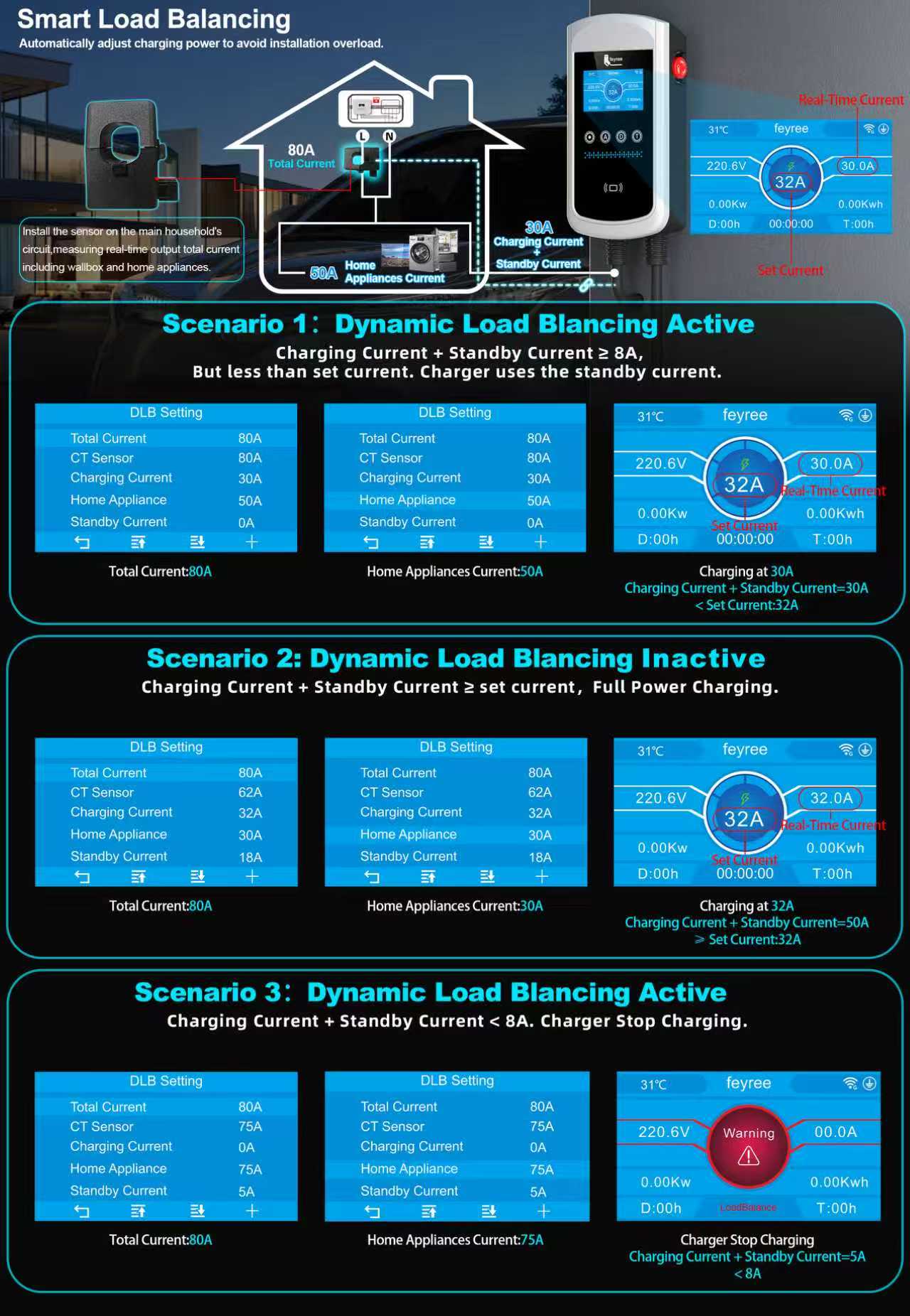
Feyree wallbox chargers support two dynamic load balancing (DLB) technical approaches tailored to different electrical environments: Meter-Based Strategy and CT Clamp-Based Strategy. The fundamental difference between these two methods lies in the measured parameter: the meter measures the dedicated load of household appliances, whereas the CT clamp measures the total incoming mains current (combining appliance load and charging load). Both strategies utilize a reliable RS485 data link between the sensor/meter and the wallbox to ensure real-time communication.
1.Meter-Based Strategy
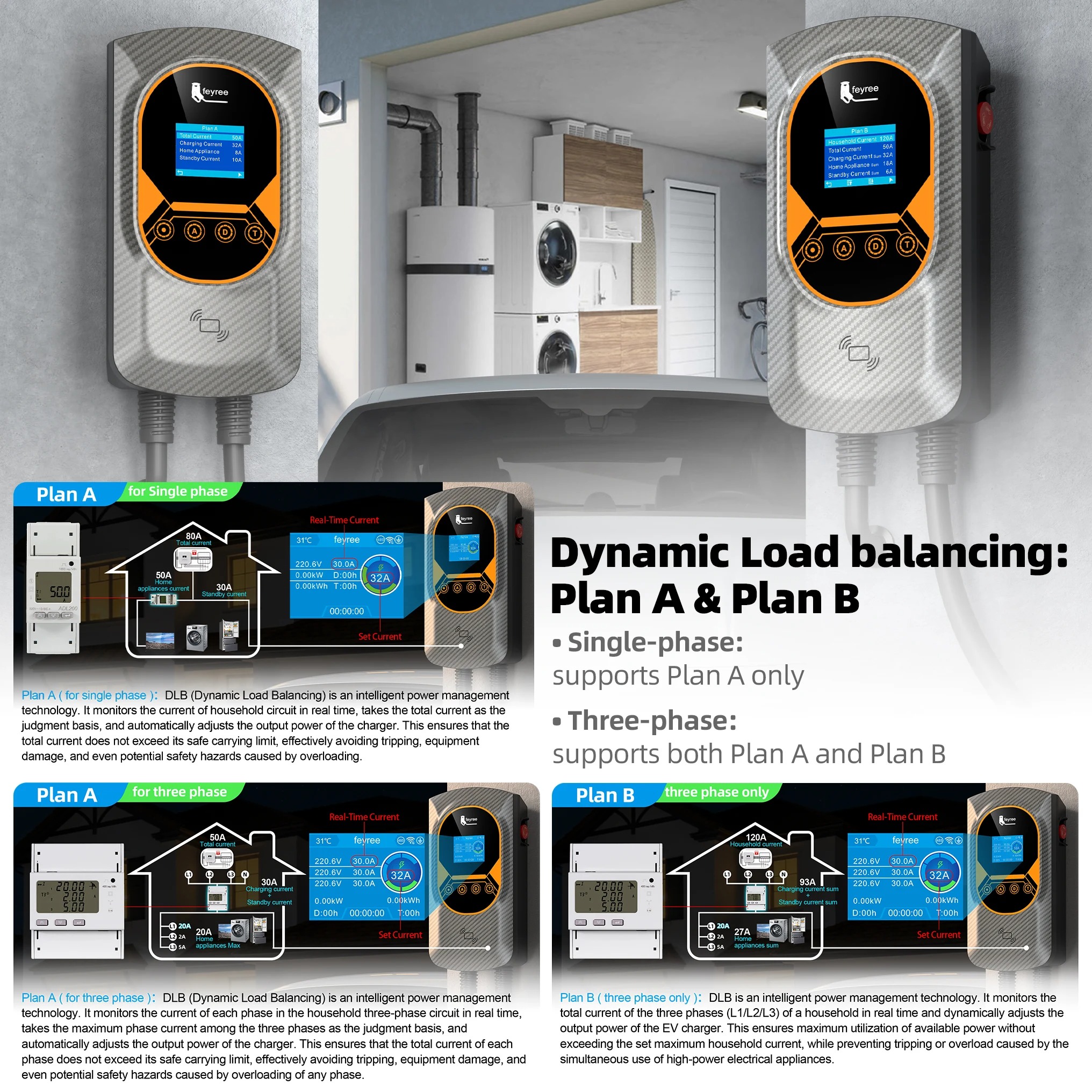
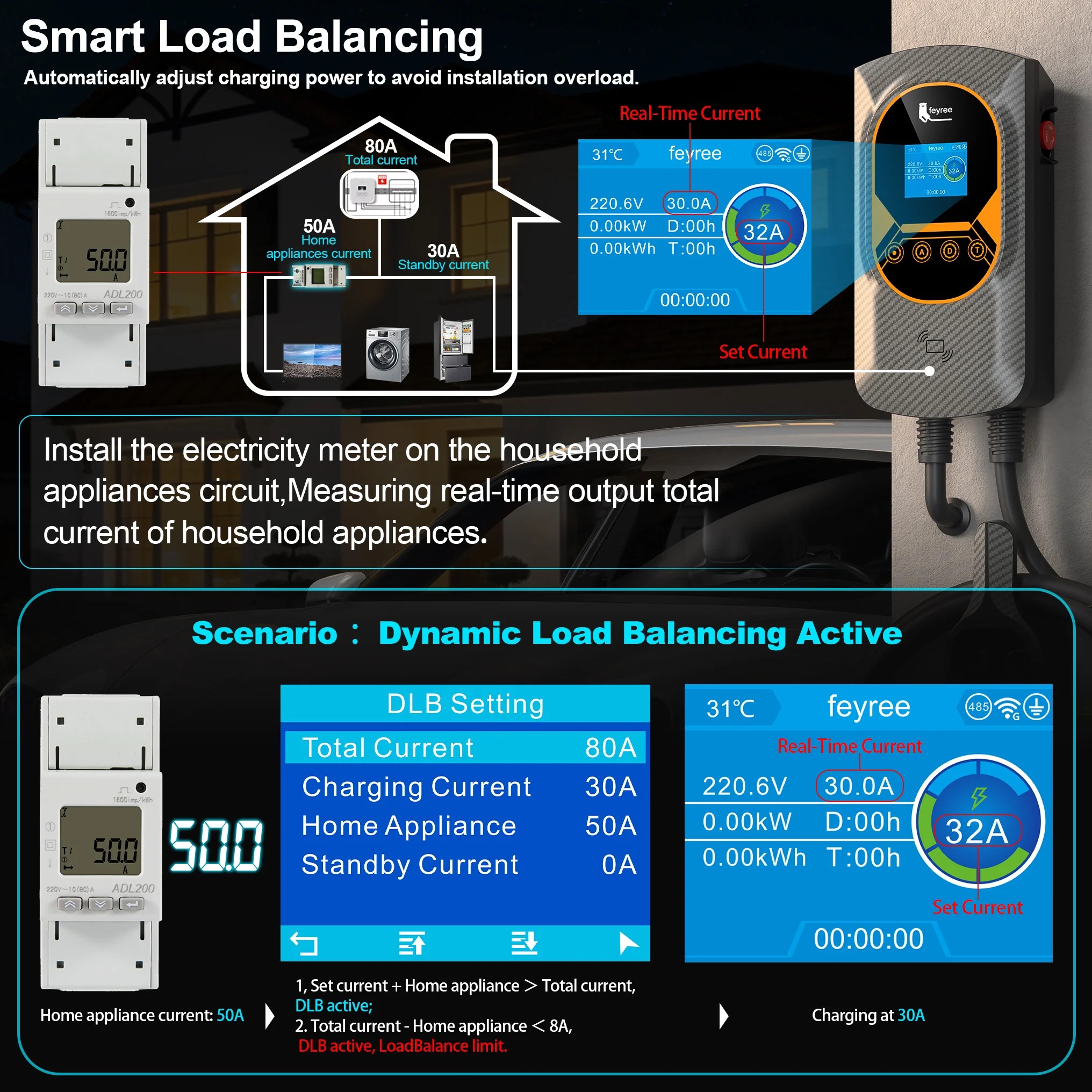
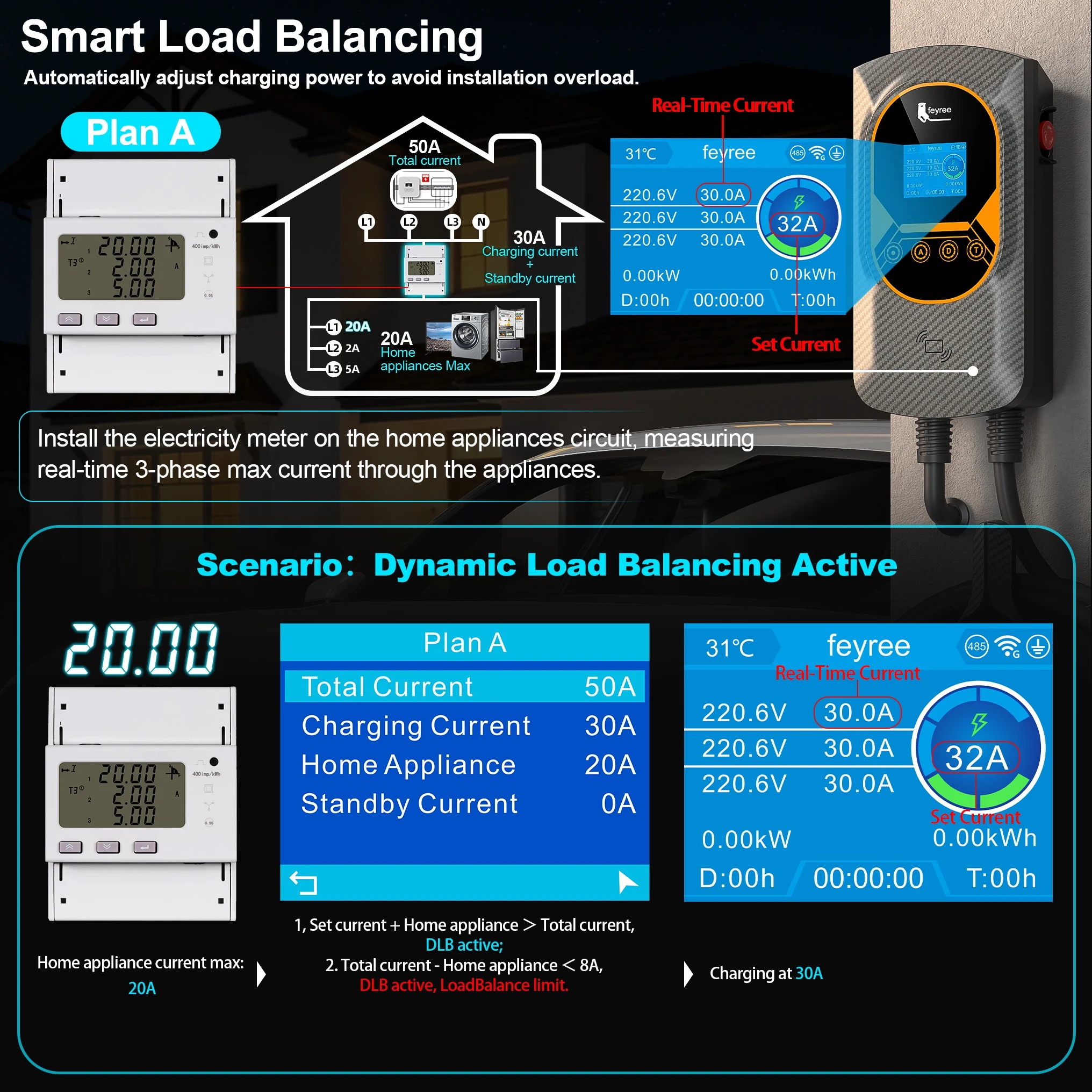
In a meter-based setup, a smart meter directly monitors real-time current consumption from household appliances and communicates with the charger to dynamically adjust output power. This strategy offers two distinct operational plans based on the grid structure:
Plan A (Universal Dynamic Load Balancing): Available for both single-phase and threephase systems. For single-phase installations, this is the only applicable plan; for threephase systems, it serves as the standard option alongside Plan B. The system continuously regulates charger output to ensure that the combined load of household appliances and EV charging never exceeds the userconfigured Household Current limit (typically between 8 A and 99 A):
Household Appliance Current + EV Charging Current ≤ Household Current Limit
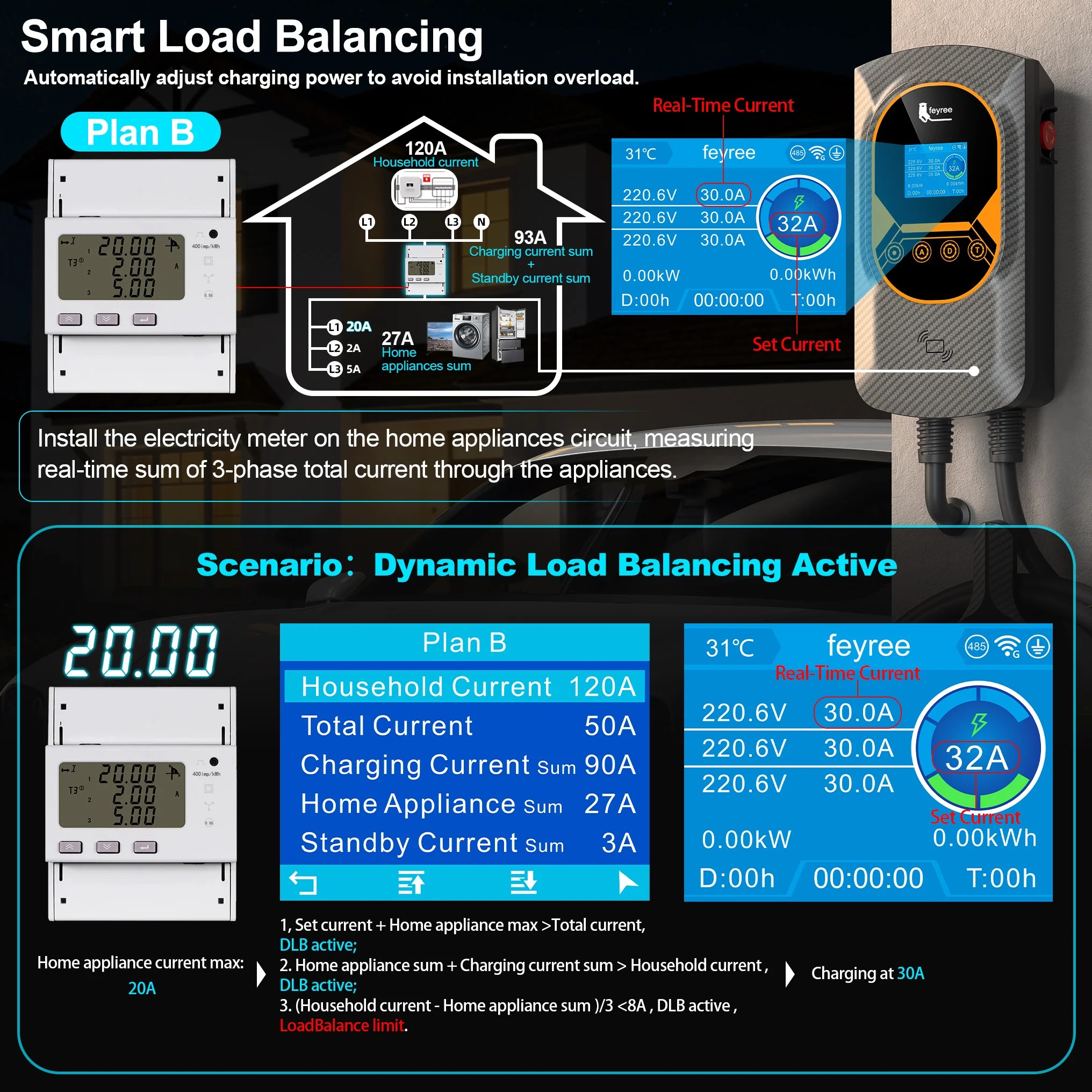
Plan B (ThreePhase Advanced Balancing): Designed for threephase electrical environments, Plan B enforces duallayer current monitoring to prevent phase imbalance and circuit overload. The charger automatically adjusts output to comply with two concurrent thresholds:
1.LineSpecific Limit: The current on any individual line (household appliance current + EV charging current) must not exceed the configured Total Current limit.
2.Overall Household Limit: The total combined current across all lines (total household appliance current + EV charging current) must remain below the configured Household Current limit.
2. CT Clamp-Based Strategy
Unlike the meter-based approach, the CT clamp-based strategy measures total incoming current directly from the main feed cable using current transformers (CT clamps) attached to each phase (L1, L2, L3).
Since the CT clamp reads the entire load (Total Current = Household Appliance Current + EV Charging Current), the system calculates available standby capacity in real time. When available current drops below the required safety threshold, charging automatically pauses to prevent main breaker trips and resumes seamlessly once grid capacity recovers.
The Pisces series wallbox with DLB is available at the Feyree Pisces product page for detailed specifications.
Safety Compliance for the European Market
European home charging installations require compliance with a specific set of safety and performance standards. Feyree wallbox products carry CE marking covering the European Union's Low Voltage Directive and Electromagnetic Compatibility requirements, and RoHS compliance for restricted hazardous substances. The integral Type B residual current device (RCD) provides AC 30 mA and DC 6 mA leakage protection — the level required for EV charging equipment under European installation standards, capable of detecting both alternating and direct fault currents. The enclosures carry IP65 or IP66 ratings, making them suitable for outdoor wall mounting in carports, driveways, and covered parking areas where exposure to rain and dust is expected. With an operating temperature range of -30°C to +55°C and UL94 V-0 flame-retardant enclosure materials, these wallbox units are specified for continuous outdoor use across European climate conditions from Nordic winters to Mediterranean summers.
Build Quality and Cable Material Standards
The physical durability of an AC wallbox depends significantly on the quality of its charging cable assembly. Feyree specifies 99.95 percent pure copper conductors for the charging cable — a purity level that minimizes resistive losses and heat generation compared to standard-grade copper cables. The cable jacket uses TPU (thermoplastic polyurethane) insulation that is TÜV certified, maintaining flexibility at low temperatures while resisting UV degradation and abrasion during daily use. The connector pins are silver-plated to 5 micrometers, providing corrosion resistance and consistent low-contact resistance across thousands of insertion cycles. The standard 5-meter cable length accommodates most parking configurations without excess slack. These material specifications are documented and consistent across production batches, giving installers and end users a verifiable standard to evaluate. More Feyree wallbox specifications are available at the official website.
Taurus and Pisces Wallbox Series for European Installations
Feyree offers two wallbox series that integrate the DLB technology described above. The Taurus series combines DLB with RFID card access control, WiFi and Bluetooth connectivity, and an IP66 weatherproof enclosure, supporting 7.6 kW, 11 kW, and 22 kW power levels across Type 2, Type 1, NACS, and GB/T connector variants. The Pisces series adds a 4.3-inch LCD color screen that displays real-time charging data including voltage, current, and session energy, alongside a 500-record charging log and 100-record fault log stored locally on the device. Both series are compatible with electric vehicles using Type 2 charging ports, including Tesla, BMW, BYD, Volvo, and Volkswagen models, and both are backed by a two-year warranty covering core components. For European homeowners and installers, the combination of adjustable DLB strategies, multi-market certification, documented material quality, and interface options — RFID, touchscreen, or mobile app — provides a practical AC wallbox solution adaptable to different installation requirements.
European home AC wallbox buyers can focus on four verifiable indicators when selecting a supplier: the range of DLB strategies supported for single-phase and three-phase installations, the depth of safety certification covering European standards, the documented material quality of the charging cable assembly, and the availability of multiple interface options for different user preferences. Feyree’s Taurus and Pisces wallbox series address each of these indicators with documented specifications and certification coverage.
More information regarding AC wallbox specifications and dynamic load balancing technology is available at the official company website: https://www.feyree.com/. Installation-specific inquiries can be directed to the technical team through the website.
FEYREE TECHNOLOGY LIMITED
FEYREE TECHNOLOGY LIMITED
+ +86 13724325548
email us here
Visit us on social media:
YouTube
TikTok
X
Legal Disclaimer:
EIN Presswire provides this news content "as is" without warranty of any kind. We do not accept any responsibility or liability for the accuracy, content, images, videos, licenses, completeness, legality, or reliability of the information contained in this article. If you have any complaints or copyright issues related to this article, kindly contact the author above.
