

Global Alginate Market Forecast, Top Companies and Growth Opportunities Reach $1.37 Billion by 2034
Alginate Market
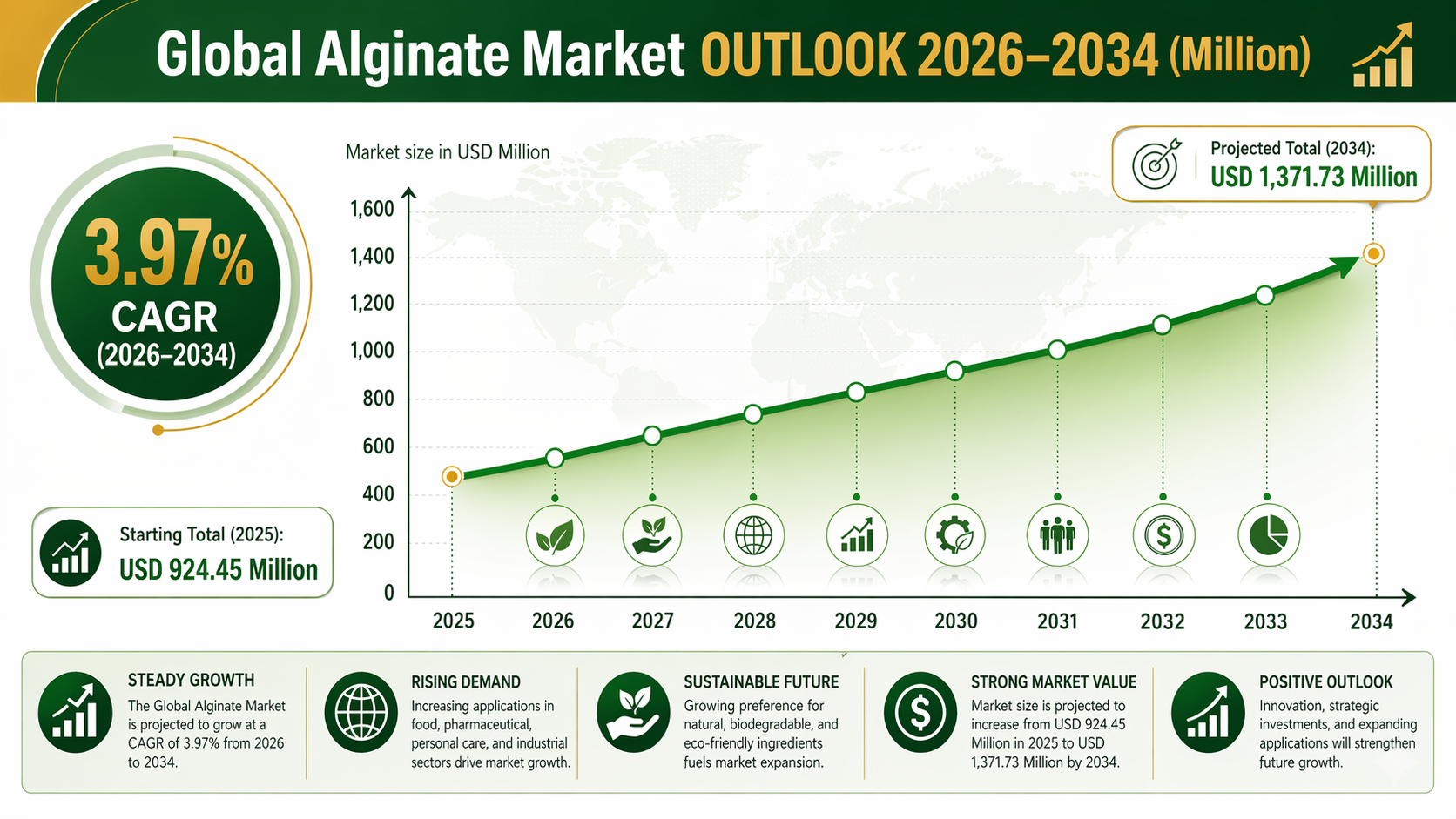
Alginate market to reach USD 1,371.73 Million by 2034 at 3.97% CAGR, driven by food stabilizers, pharma use, and sustainable seaweed production.
NEW YORK, NY, UNITED STATES, April 22, 2026 /EINPresswire.com/ -- According to a research report by IMARC Group, the global alginate market size reached USD 924.5 Million in 2025. The market is projected to reach USD 1,371.7 Million by 2034, exhibiting a growth rate (CAGR) of 3.97% during 2026–2034. The global market is flourishing, driven by its growing use in food and beverage as a natural stabilizer, expanding pharmaceutical applications for drug delivery and wound healing, and advancements in biotechnology and sustainable seaweed cultivation.Market Highlights
• Rising demand for clean-label and natural food stabilizers
• Increasing adoption in pharmaceutical drug delivery and wound care applications
• Expansion of sustainable seaweed cultivation and raw material sourcing
• Growing use in plant-based meat and dairy alternatives for texture and binding
• Advancements in bioprinting and regenerative medicine applications
• Increasing demand from cosmetics and personal care for skin-conditioning properties
• Rising focus on biodegradable and eco-friendly hydrocolloids
• Expansion of applications in industrial and agricultural sectors, including seed coating and textiles
Request for a Sample Report for Detailed Evaluation: https://www.imarcgroup.com/alginate-market/requestsample
What Is Driving Alginate Market Growth in 2026?
Growing Demand in Food and Beverage Industry:
The market is significantly influenced by its expanding use in the food and beverage industry. Alginate, a natural polysaccharide extracted from brown seaweed, acts as a stabilizer, thickener, and emulsifier in various food products. Its unique gelling, film-forming, and ice crystal prevention properties make it ideal for applications in ice creams, dairy products, and salad dressings. The rising consumer preference for natural food additives over synthetic ones due to health concerns is propelling market growth. As the food industry continues to innovate and expand, especially in developing economies, the demand for this seaweed extract is expected to grow steadily.
Increased Usage in Pharmaceutical Applications:
Natural polysaccharides are gaining traction in the pharmaceutical sector due to their biocompatibility, non-toxicity, and ability to enhance drug delivery. They are increasingly used in wound dressings, providing optimal conditions for wound healing by maintaining moisture balance and promoting tissue regeneration. The pharmaceutical industry is also exploring natural polysaccharides in drug encapsulation and controlled release systems, leveraging their gel-forming capabilities. As pharmaceutical companies continue to invest in R&D activities, the alginate market is expected to benefit substantially from these advancements, making it a versatile and vital ingredient in modern medicine.
Advancements in Biotechnology and Seaweed Cultivation:
Technological progress in biotechnology and seaweed cultivation is a key factor propelling the market forward. Enhanced cultivation techniques have led to increased and more sustainable seaweed production, the primary raw material for alginate. This increase in supply has the potential to stabilize prices and improve market accessibility. Advancements in biotechnology are also improving extraction and processing methods, making alginate production more efficient and environmentally friendly. These technological strides are critical in meeting the rising demand for natural polysaccharides across diverse industries, thereby fueling market growth in the years ahead.
Explore detailed insights, industry trends, and future outlook of the alginate market: https://www.imarcgroup.com/alginate-market
Alginate Market Segmentation Analysis:
By Type
• High M
• High G
High G alginate represents the largest segment within the market. High G alginate, distinguished by its elevated guluronic acid content, dominates due to the remarkable gelling properties it possesses, making it a highly sought-after ingredient across various industries. In the food and beverage sector, High G alginate acts as a superior gelling agent, thickener, and stabilizer, enhancing the texture and quality of numerous products, from dairy items to sauces and desserts. It also plays a pivotal role in pharmaceutical and cosmetics industries, contributing to controlled-release drug delivery systems and stable emulsions.
By Product
• Sodium Alginate
• Calcium Alginate
• Potassium Alginate
• Propylene Glycol Alginate
• Others
Propylene Glycol Alginate (PGA) leads the market with the largest share in the industry. PGA is renowned for its exceptional stabilizing and emulsifying properties, making it a preferred choice in food and beverage applications such as salad dressings, beverages, and ice creams. Its versatility extends to the pharmaceutical industry for controlled-release drug formulations and to the cosmetics and personal care sector for stable emulsions and creams. Sodium alginate, derived from brown seaweed, is also widely valued for its thickening and gelling properties in food production, while calcium alginate finds key applications in wound care and medical dressings.
By Application
• Food and Beverages
• Pharmaceuticals
• Cosmetics
• Others
Food and Beverages lead the market as the largest application segment. Alginate’s exceptional gelling, thickening, and stabilizing properties find widespread use in this industry, serving as an integral component in dairy items, salad dressings, fruit gels, and beverages. Alginate ensures the desired texture and consistency while extending the shelf life of products. In the pharmaceutical industry, alginate serves as a critical component in drug delivery systems and wound care products where its biocompatibility and gel-forming properties are highly advantageous. Cosmetics represent a smaller but growing segment where alginate aids in achieving desired textures and product stability.
By Region
• Asia Pacific
• North America
• Europe
• Latin America
• Middle East and Africa
Europe leads the market with the largest alginate market share — driven by its robust healthcare and pharmaceutical sectors, where alginate is extensively used for wound dressings and dental products. The food industry in Europe, particularly in France, Germany, and the UK, heavily relies on alginate for thickening, gelling, and stabilizing applications. Stringent EU food safety regulations contribute to the high-quality standards maintained in alginate production. In Asia Pacific, the market is driven by expanding food and beverage industries in China, Japan, and India, as well as traditional use of seaweed-based products and a burgeoning textile industry.
Key Regional Insight: Europe’s Strategic Position:
Europe accounts for the majority share of the alginate market due to its advanced healthcare infrastructure, stringent food safety standards, and well-established food and pharmaceutical industries. Countries like France, Germany, the UK, and Italy maintain strong demand for high-quality alginate across diverse industrial applications. The region’s pharmaceutical sector continues to invest heavily in alginate-based wound care and drug delivery technologies, while food manufacturers increasingly rely on this natural polysaccharide to meet consumer preferences for clean-label ingredients. With ongoing R&D investments and sustainability-focused production, Europe remains the global leader in alginate consumption and innovation throughout the forecast period.
Connect for Detailed Segmentation Analysis – Speak to an Analyst: https://www.imarcgroup.com/request?type=report&id=3331&flag=C
Competitive Landscape in the Alginate Industry:
The alginate market is highly competitive, with key global players focused on innovation, expanding product portfolios, and strategic mergers and acquisitions to strengthen their market positions. Rising demand for eco-friendly and high-performance alginate has prompted significant R&D investments. Manufacturers are increasingly emphasizing sustainability, including responsible seaweed sourcing and environmentally friendly processing methods. Regional players cater to specific local needs in food, pharmaceuticals, and cosmetics, further intensifying competition. The adoption of advanced technologies for improving extraction efficiency and product quality differentiates market leaders as demand grows across diverse application sectors.
Key Alginate Market Players Include:
• Algaia SA (Maabarot Products Ltd.)
• Compañia Española de Algas Marinas (CEAMSA)
• DuPont De Nemours Inc.
• Ingredients Solutions Inc.
• IRO Alginate Industry Co. Ltd.
• KIMICA Corporation
• Marine Biopolymers Limited
• Shandong Jiejing Group Corporation
• SNAP Natural & Alginate Product Pvt. Ltd.
• SNP Inc.
Market Drivers, Challenges & Opportunities:
Major Market Drivers:
• Rising consumer preference for natural food additives driving adoption of alginate as a stabilizer, thickener, and emulsifier across food and beverage industries globally.
• Expanding pharmaceutical applications including drug delivery systems, wound care products, and tissue engineering, fueled by alginate’s biocompatibility and gel-forming properties.
• Technological advancements in seaweed cultivation and biotechnology improving supply chain sustainability and enabling more efficient alginate extraction and processing.
Key Challenges:
• Fluctuations in seaweed availability and seasonal supply variability impacting production consistency and raw material pricing for alginate manufacturers.
• Need for continuous R&D investment to develop new alginate applications and formulations across emerging sectors such as regenerative medicine and biotechnology.
Emerging Opportunities:
• Growing exploration of alginate in regenerative medicine and tissue engineering, with its biocompatibility and gel-forming properties enabling novel applications in healthcare and medical technology.
• Rising demand for sustainable, natural, and clean-label ingredients across food, cosmetics, and pharmaceutical sectors aligned with global consumer sustainability trends.
• Expansion into untapped emerging markets in Asia Pacific, Latin America, and Middle East and Africa as food, pharmaceutical, and textile industries grow and diversify product portfolios.
People Also Ask:
How big is the global alginate market in 2025?
The global alginate market reached USD 924.5 Million in 2025. It is projected to grow to USD 1,371.7 Million by 2034, expanding at a CAGR of 3.97% during 2026–2034.
What is the growth rate of the alginate market?
The alginate market is expected to grow at a CAGR of 3.97% from 2026 to 2034, driven by increasing demand in food stabilizers, pharmaceutical applications, and sustainable seaweed production.
Which region dominates the alginate market?
Europe leads the global alginate market due to its strong pharmaceutical sector, advanced healthcare infrastructure, and high demand for clean-label food ingredients.
What are the key applications of alginate?
Alginate is widely used in food and beverages as a stabilizer and thickener, in pharmaceuticals for drug delivery and wound care, and in cosmetics for texture and skin-conditioning properties.
Which product segment leads the alginate market?
Propylene Glycol Alginate (PGA) holds the largest share due to its superior stabilizing and emulsifying properties across food, pharmaceutical, and personal care applications.
Which type of alginate is most widely used?
High G alginate dominates the market because of its strong gelling properties, making it suitable for food processing, pharmaceutical formulations, and cosmetic applications.
Who are the key players in the alginate market?
Key companies include Algaia SA, CEAMSA, DuPont De Nemours Inc., KIMICA Corporation, Marine Biopolymers Limited, and Shandong Jiejing Group Corporation.
Conclusion: Alginate Market Outlook to 2034:
The alginate market is poised for steady and sustained growth through 2034, underpinned by the convergence of rising demand for natural ingredients, expanding pharmaceutical applications, and continuous advancements in biotechnology and seaweed cultivation. As consumers globally shift toward clean-label and sustainable food products, and as the pharmaceutical sector continues to explore alginate’s versatile properties in drug delivery and wound care, the market’s growth trajectory remains strongly positive.
With Europe cementing its dominant position and Asia Pacific witnessing robust growth driven by expanding food industries and traditional seaweed usage, the alginate market outlook remains favorable across both developed and emerging economies throughout the forecast period.
About the Author
IMARC Group is a leading global market research company providing data-driven insights and expert consulting services to businesses seeking to achieve their strategic objectives. With a multi-disciplinary team of industry experts, IMARC delivers thorough, reliable market intelligence across sectors including Technology, Construction, Healthcare, Energy, Chemicals, Food & Beverages, and more.
Elena Anderson
IMARC Services Private Limited
+1 201-971-6302
email us here
Legal Disclaimer:
EIN Presswire provides this news content "as is" without warranty of any kind. We do not accept any responsibility or liability for the accuracy, content, images, videos, licenses, completeness, legality, or reliability of the information contained in this article. If you have any complaints or copyright issues related to this article, kindly contact the author above.
