
Peat Market to Reach USD 2,229.68 Million by 2032, Carbon Stewardship and Peat-Free Mandates Fuel Growth
Peat Market graph
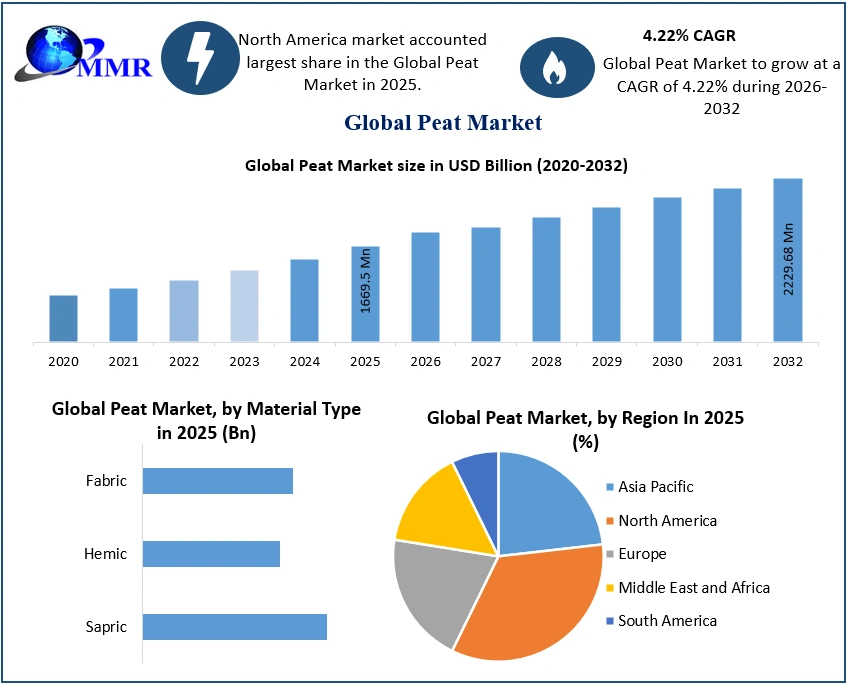
The Peat Market was valued at USD 1,669.5 million in 2025 and is projected to reach USD 2,229.68 million by 2032, growing at a CAGR of 4.22%.
Can AI save the soil? Maximize Market Research explores how digital monitoring is securing the 2026 peat-free supply chain.”
ROCKVILLE , MD, UNITED STATES, March 18, 2026 /EINPresswire.com/ -- In 2026, the peat industry has reached a structural point of no return. While the Global Peat Market was valued at USD 1,669.5 Million in 2025 and is projected to reach USD 2,229.68 Million by 2032 at a 4.22% CAGR, the composition of that value is undergoing a radical shift. The "Professional Phase-Out" now taking hold across the UK and European markets has moved the regulatory ban from retail garden centers to commercial nursery operations, creating a massive supply-chain recalibration.— Maximize Market Research
Get Full PDF Sample Copy of Report: (Including Full TOC, List of Tables & Figures, Chart) @ https://www.maximizemarketresearch.com/request-sample/12125/
According to Maximize Market Research, this isn't merely a material shortage; it's a fundamental transformation of the soil science economy. Traditional peat extraction is increasingly restricted to protect the planet’s largest terrestrial carbon sinks. Consequently, market value is migrating from raw extraction volume to the R&D of high-purity bio-substrates. The 2026 narrative is defined by the "Horticultural Pivot," where professional growers are forced to balance crop quality with a 2026 "legislative cliff" that mandates a move away from legacy peat-based media.
The Peat Frontier: Carbon Removal Credits and the Rise of "Smart Substrates"
In 2026, the peat market is being redefined by its transition from a horticultural commodity to a high-value climate asset. A dominant trend identified is the "Securitization of Peatlands," where dormant extraction sites are being converted into Carbon Removal (CDR) projects. With the voluntary carbon market seeking high-integrity "nature-based" solutions, companies are finding that "rewetting" degraded bogs can be more profitable than harvesting them for fuel or soil.
This shift is mirrored in the technology sector through the development of "Smart Substrates." These are hybrid growing media that combine minimal peat volumes with AI-optimized additives like biochar and wood fiber to maintain moisture retention. A compelling real-world example is Bord na Móna’s total pivot from Ireland’s largest peat harvester to a "Climate Solutions" company, now focusing on renewable energy and bog restoration to generate lucrative biodiversity credits. Furthermore, the 2026 market is witnessing a surge in "Peat-Free Verification" blockchain tech, allowing retailers to prove the sustainability of their supply chains to an increasingly litigious regulatory environment. This "Restoration-First" economy is now the primary driver of the sector.
Regional Resource Realignment: Canada’s Supply Supremacy vs. Europe’s Legislative Contraction
The geography of the USD 2,229.68 Million peat market is currently undergoing a "Strategic Decoupling." While Europe has traditionally been the volume leader, accounting for 44.22% of global consumption in 2025, the region is now facing a structural contraction. Rigorous EU directives and the UK’s 2026 "Professional Ban" on peat sales are forcing a massive exit from extraction, shifting the focus toward bog restoration and carbon accounting.
In stark contrast, North America valued at USD 645.13 Million in 2025 is solidifying its role as the global supply anchor. Canada remains the undisputed export powerhouse, with a 2026 trajectory defined by high-value shipments to the United States and emerging markets in Asia-Pacific. Industry leaders like Berger Peat Moss are illustrating this realignment by securing long-term export deals with Saudi-based agri-tech firms to support desert agriculture, proving that while European demand is legislated downward, the global reliance on Canadian Sphagnum for food security remains at an all-time high. This regional divergence ensures that North America will maintain a robust CAGR, even as other regions pivot toward total peat-free alternatives.
The Substitute Supremacy: Material Stratification and the Rise of High-Purity Bio-Substrates
The peat landscape is undergoing a rigorous stratification as the industry pivots toward high-performance alternatives. The market is no longer a monolithic extraction sector but is now defined by "Material Hybridization." The Coco Peat segment has emerged as the dominant volume driver, currently capturing a 44.5% market share. This shift is propelled by its superior moisture retention and its role as the primary "peat-free" bridge for professional growers facing the 2026 legislative cliff.
Simultaneously, the market is bifurcating between Hemic and Sapric peat types. While Hemic peat remains a staple for traditional horticultural applications, Sapric peat is seeing a specialized surge in the Restoration and Environmental segments. Furthermore, the market is witnessing a 12% rise in Wood Fiber and Bark-based composites, which are being engineered to mimic the air-porosity of sphagnum. This segmentation proves that the most resilient revenue streams are no longer in raw peat volume, but in the sophisticated blending of renewable bio-substrates that meet the stringent 2026 "Peat-Free" certification standards.
By Type
Coco Peat
Sod Peat
Others
By Material Type
Sapric
Hemic
Fabric
By End User
Agriculture
Fuel & Energy
Domestic
Medicine
Others
By Distribution Channel
Direct Sales
Retail & Wholesale Distribution
Online Platforms
Get Full PDF Sample Copy of Report: (Including Full TOC, List of Tables & Figures, Chart) @ https://www.maximizemarketresearch.com/request-sample/12125/
Analyst Perspective – The Transition from "Horticultural Commodity" to "Climate-First Asset Class"
At Maximize Market Research, we view the USD 2,229.68 Million peat market as a sector in the midst of a historic "valuation flip." The 4.22% CAGR is no longer driven by traditional extraction, but by the emergent Restoration Economy. Our analysts have identified a massive "Flight to Quality" where high-integrity Carbon Removal Credits from rewetted peatlands are outperforming raw material sales in profitability.
We believe the industry’s future lies in "Smart Substrates"—blends that leverage AI-monitored bio-additives to maintain crop yields while meeting the 2026 "Peat-Free" legislative cliff. For stakeholders, the mandate is clear: the most resilient revenue streams will belong to those who pivot from being peat extractors to becoming Carbon Stewardship Managers.
The Global Peat Contours: Assessing Competitive Resilience in a Transformed Regulatory Landscape
The competitive dynamics of the peat market are currently defined by a "Strategic Bifurcation" between regional powerhouses. In North America, entities such as Sun Gro Horticulture and Lambert Peat Moss are solidifying their dominance by integrating bio-additives like biochar into their professional mixes, effectively future-proofing against shifting soil-health standards. Simultaneously, Europe serves as the center for technical innovation, with Klasmann-Deilmann and Neova Oy leading the transition from traditional harvesters to "Carbon Stewardship" managers through large-scale bog restoration and peat-reduced substrate engineering.
In the high-growth Asia-Pacific corridor, players like Heng Huat Resources Group (HHRG) and Sai Cocopeat are leveraging their proximity to coconut biomass to dominate the "Substitute Supremacy" segment. This global realignment proves that market leadership in 2026 is no longer predicated on extraction volume alone, but on the ability of legacy players including Berger Peat Moss and Lambert to balance horticultural performance with the increasingly stringent requirements of the carbon-neutral economy.
Key players in Global Peat Market
AB Rėkyva
American Peat Technology, LLC
Annapolis Valley Peat Moss Co.
Beltwide Inc.
Lambert Peat Moss
Sun Gro Horticulture
Theriault & Hachey Peat Moss Ltd.
Peat Based LLC
Profile Products LLC (USA)
AS Tootsi Turvas
BALT WOOD ENTERPRISE SIA
Berger Peat Moss
Clover Peat
Dockers LLC
Dutch Plantin Coir India Pvt. Ltd.
HAWITA Gruppe GmbH
Klasmann-Deilmann GmbH
Neova Oy
Peatfield
Tippland Horticulture
Get access to the full description of the report @ https://www.maximizemarketresearch.com/market-report/peat-market/12125/
FAQ
Q1: What are the 2026 professional peat exemptions?
Ans: Under the latest UK and EU mandates, most professional horticulture must transition by 2026. However, exemptions remain for plug plants, mushroom production, and specific scientific conservation efforts through 2030, provided no viable bio-substitute is available.
Q2: How does peat-free media impact irrigation?
Ans: Peat-free alternatives like wood fiber often have lower water retention. Maximize Market Research suggests a "little and often" irrigation strategy and increased nitrogen buffering to offset the initial "lock-up" common in non-peat substrates.
Q3: Is 100% peat-free commercially viable for large-scale nurseries?
Ans: Yes. Companies like Syngenta Flowers have already moved major assortments, such as Pelargoniums, to 100% peat-free plugs, proving that with adjusted fertigation, industrial-scale quality is maintainable.
Q4: Can rewetted peatlands generate income?
Ans: Absolutely. Through Carbon Removal (CDR) credits, landowners can now monetize "rewetted" bogs, which often prove more profitable than extraction due to the rising value of high-integrity nature-based credits.
Related Reports
Specialty Fertilizers Market: https://www.maximizemarketresearch.com/market-report/specialty-fertilizers-market/199861/
Soil Conditioners Market: https://www.maximizemarketresearch.com/market-report/barefoot-shoes-market/186746/
Biochar Market: https://www.maximizemarketresearch.com/market-report/biochar-market/11779/
Biomass Gasification Market: https://www.maximizemarketresearch.com/market-report/biomass-gasification-market/66858/
Top Reports:
Guar Gum Market
Garage Door Market
About Maximize Market Research
Maximize Market Research is a global business consulting entity specializing in high-impact industrial shifts. We empower Fortune 500 organizations with data-driven strategies to navigate complex market cycles and secure long-term dominance.
Domain Focus: Soil Science & Carbon Stewardship
Our team evaluates high-performance horticultural ecosystems and advanced substrate engineering. We analyze the lifecycle economics of Peatland Carbon Sinks, from the transition to peat-free bio-composites and sphagnum-based cultivation to the integration of wetland rewetting models into the global Nature-Based Solutions (NBS) and Carbon Removal (CDR) economies.
Lumawant Godage
MAXIMIZE MARKET RESEARCH PVT. LTD.
+ +91 96073 65656
email us here
Visit us on social media:
LinkedIn
Instagram
Facebook
X
Legal Disclaimer:
EIN Presswire provides this news content "as is" without warranty of any kind. We do not accept any responsibility or liability for the accuracy, content, images, videos, licenses, completeness, legality, or reliability of the information contained in this article. If you have any complaints or copyright issues related to this article, kindly contact the author above.
