
ICAIE Releases Report on How Criminals Accelerating Illicit Trade by Exploiting Emerging Transaction Laundering Schemes
Money Laundering Methodologies
ICAIE
The Dark Side of Illicit Economies: Digital Assets and Transaction “Value” Schemes are Being Leveraged to Finance a Global Ecosystem of Criminality
We must leverage public-private partnerships to enhance information- and intelligence-sharing to target crminals' corruptive influence and financial wherewithal.
laundering of the dirty monies.”
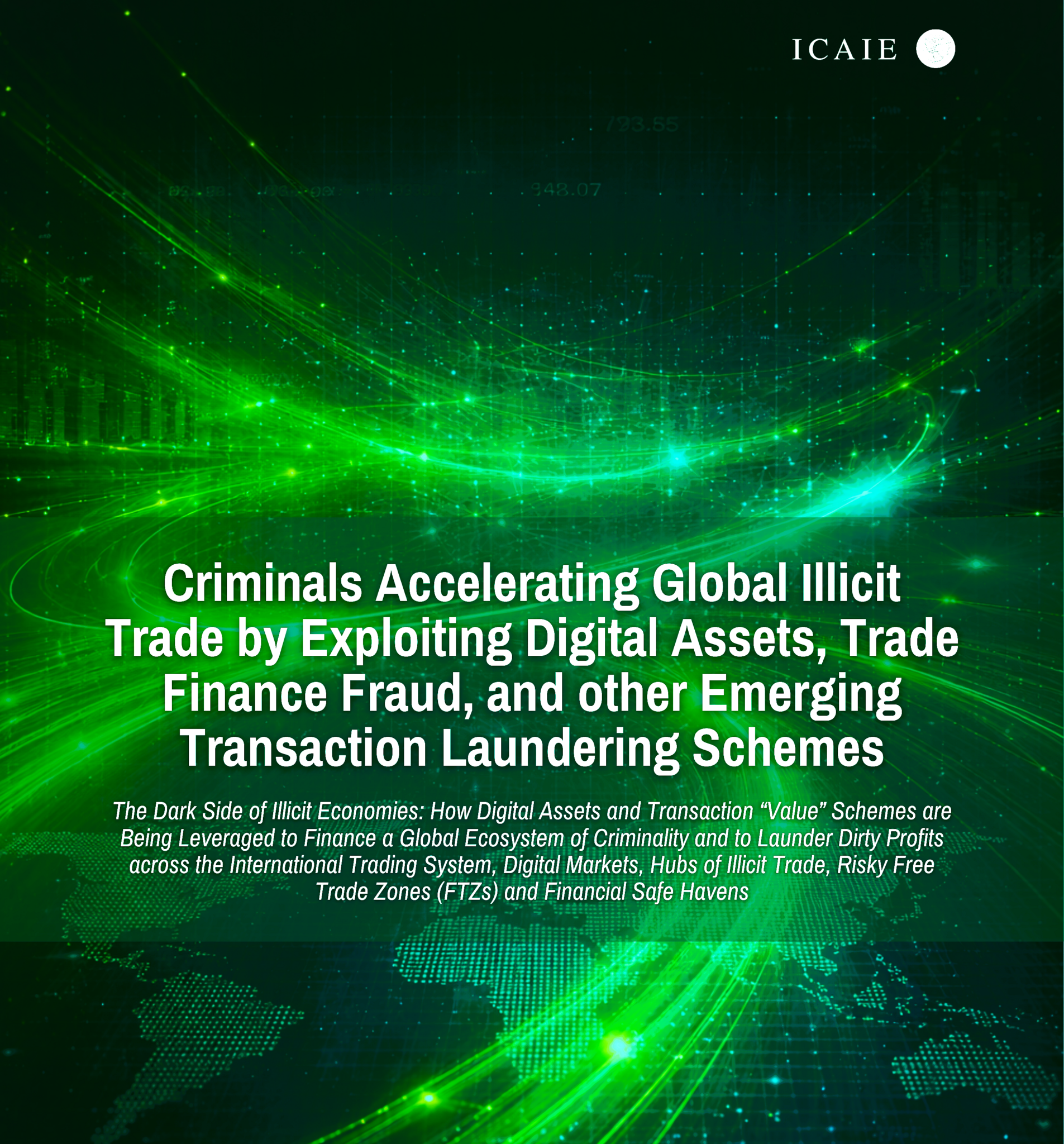
WASHINGTON, DC, UNITED STATES, March 10, 2026 /EINPresswire.com/ -- The International Coalition Against Illicit Economies (ICAIE) today released their latest strategic intelligence report on how newer schemes of money laundering and threat finance – especially across the digital world – are helping to expand the global illegal economy. The new ICAIE report is entitled, “Criminals Accelerating Global Illicit Trade by Exploiting Digital Assets, Trade Finance Fraud, and other Emerging Transaction Laundering Schemes”, co-authored by John A. Cassara and David M. Luna.— David M. Luna
The Spring 2026 ICAIE Report highlights the issue that within illicit economies, digital assets and transaction “value” schemes are being leveraged by bad actors and criminal networks to finance a global ecosystem of criminality and to launder dirty profits across the international trading system, digital markets, hubs of illicit trade, risky free trade zones (FTZs), and financial safe havens.
Across today’s global security landscapes, a worldwide network of trade, commerce, and illicit activities is thriving, with the selling and buying of legal and illicit goods and services taking place through electronic and digital payouts across online connections, global trading systems, e-commerce marketplaces, apps, social media, and encrypted channels.
David M. Luna, ICAIE Executive Director, said that “this new global market architecture is exploited by criminals to move dirty funds in all corners of the globe through digital technologies, the internet, mobile phones, and data-driven AI, IoT, and cloud/quantum computing.”
Globalized trade and tariff rows have also created new arbitrage opportunities for criminal across low-tariff markets, trans-shipment points, fraudulent schemes that misuse country of origin declarations, and trade-based money laundering that uses cryptocurrency for payment settlement.
As international trade and commerce are further digitized, the evolution of today’s payment systems has also altered the security landscapes used to detect and fight money laundering and financial crime, especially as markets shift towards digital currencies and a cashless economy where “value” becomes the operative payment method for transactions.
Criminals have seized on globalization that exploits digital commerce to finance an international ecosystem of criminality and illicit trade that is siphoning trillions of dollars from legal economies.
The IMF estimates that international money laundering accounts for between 2-5% of world GDP (or up to $6 trillion based on the global economy – $117 trillion in GDP – in 2025). Of course, it depends on what is included in the count. We don’t know the IMF’s dated internal calculations and methodology in deriving its estimate. But it doesn’t appear, for example, tax evasion is included in the IMF estimate. Yet tax evasion is a now a predicate offense for money laundering in many countries and jurisdictions.
As this report elaborates, new forms of money laundering are rapidly escalating, such as those driven by artificial intelligence and crypto-currencies. So, the actual magnitude of money laundering could be much greater than the generally accepted $6 trillion 2026 estimate, and that has cascading negative effects and critical domestic and international policy implications.
The lucrative multi trillion-dollar global illicit economy includes an array of cybercrimes as well as the smuggling and trafficking of narcotics, opioids, weapons, humans, fake medicines, counterfeit and pirated goods; illegal tobacco and alcohol products; illegally harvested timber, wildlife and fish; pillaged oil, diamonds, gold, natural resources and critical minerals; and other illicit commodities and contraband.
Transaction laundering takes advantage of the seams and vulnerabilities in the global financial system and the digital world. In this newer reality, illicit finance trends continue to evolve including in emerging digital markets and underground banking systems through pseudo-anonymity, digital assets, and a lack of uniform regulation related to crypto and virtual currencies, Non-Fungible Tokens (NFTs), and online gaming and decentralized finance (DeFi) platforms
ICAIE brings together diverse champions across sectors and communities, including governments and prominent organizations from the private sector and civil society to mobilize energies to combat cross-border illicit threats that endanger U.S. national security, global supply chains, and international peace.
Find Full ICAIE Report here and visit us at: https://icaie.com/2026/03/criminals-accelerating-global-illicit-trade-by-exploiting-digital-assets-trade-finance-fraud-and-other-emerging-transaction-laundering-schemes/
David Manuel Luna
International Coalition Against Illicit Economies (ICAIE)
email us here
Visit us on social media:
LinkedIn
Legal Disclaimer:
EIN Presswire provides this news content "as is" without warranty of any kind. We do not accept any responsibility or liability for the accuracy, content, images, videos, licenses, completeness, legality, or reliability of the information contained in this article. If you have any complaints or copyright issues related to this article, kindly contact the author above.
