

Pumpkin Seed Protein & Fiber Market Forecast 2026–2036: Global Market to Reach USD 1,560.0 Million by 2036 at 10.2% CAGR
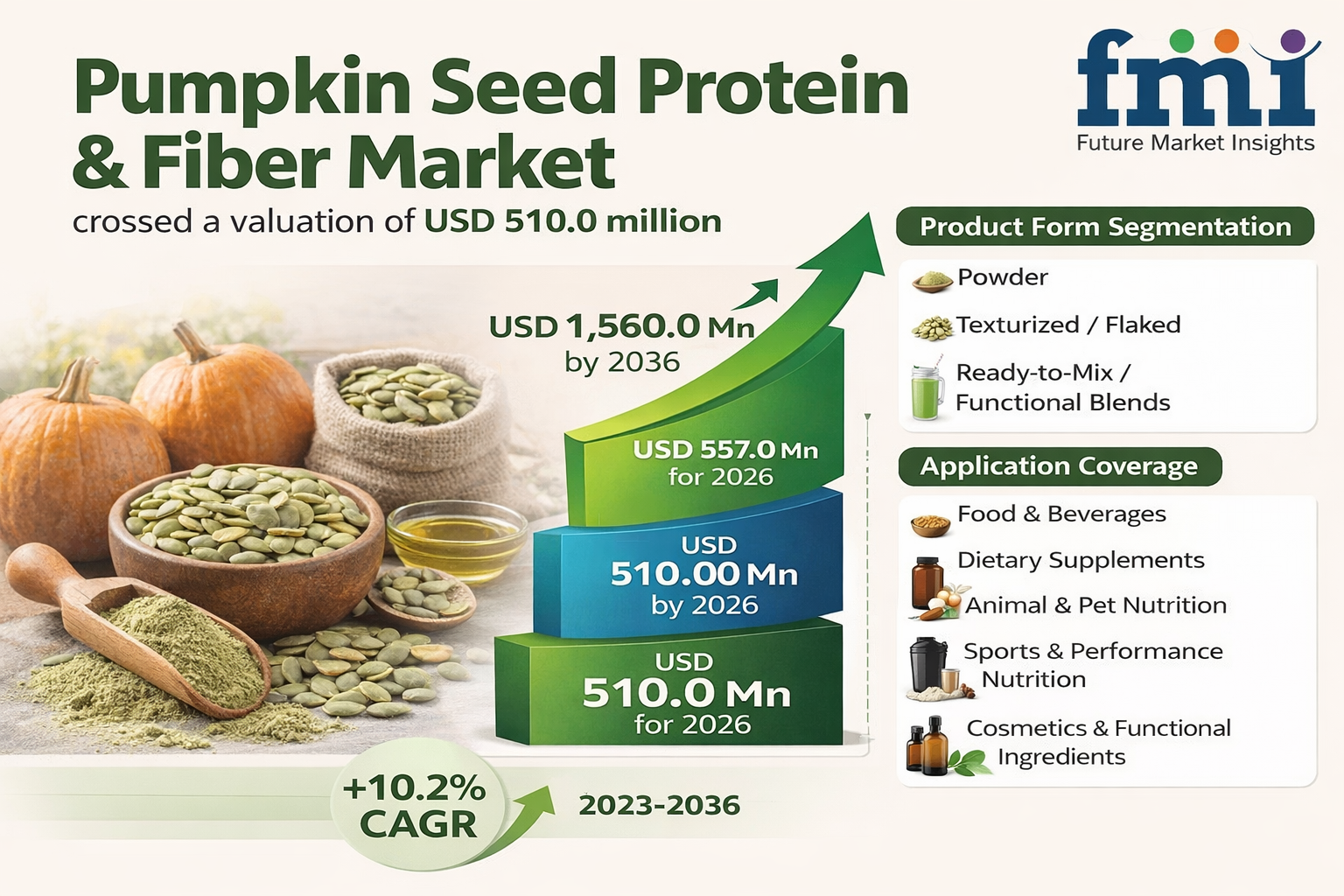
Pumpkin Seed Protein & Fiber Market
Pumpkin seed protein & fiber market grows on clean-label reformulation, plant-based demand, and dual protein-fiber fortification trends globally.
NEWARK, DE, UNITED STATES, March 2, 2026 /EINPresswire.com/ -- The global pumpkin seed protein & fiber market crossed a valuation of USD 510.0 million in 2025 and is projected to reach USD 557.0 million in 2026. According to Future Market Insights (FMI), the market is forecast to surge to USD 1,560.0 million by 2036, reflecting a robust 10.2% CAGR. Procurement specifications are increasingly shifting toward dual-action functional ingredients that deliver both protein enrichment and digestive support.
Buyers are prioritizing seed-derived extracts over traditional dairy and soy proteins to clear stringent clean-label qualification benchmarks. As global retail plant-based food sales reached USD 28.6 billion in 2024, ingredient substitution cycles are accelerating across beverage, bakery, and nutritional supplement categories.
Request For Sample Report | Customize Report | Purchase Full Report - https://www.futuremarketinsights.com/reports/sample/rep-gb-32130
Plant-based scale is now dictating capacity investments. Formulation teams are systematically replacing highly processed soy derivatives with hypoallergenic seed fractions during routine product upgrades. Procurement managers are locking in long-term acreage contracts to hedge against raw material volatility and protect operating margins.
Market Definition and Scope
Pumpkin seed protein and fiber refer to functional food ingredients extracted via cold-pressing and precision milling processes. These derivatives are standardized for business-to-business sales to food and beverage manufacturers seeking plant-based fortification inputs.
Inclusions:
Concentrated protein powders, isolated fractions, and dietary fiber extracts derived entirely from pumpkin feedstocks.
Exclusions:
Whole raw pumpkin seeds for retail snacking, pumpkin seed oil for culinary use, finished consumer products, and animal feed-grade byproducts.
Key Market Metrics
• Industry Size (2026): USD 557 Million
• Industry Value (2036): USD 1,560 Million
• CAGR (2026–2036): 10.2%
Segmental Insights
Protein concentrates and isolates dominate product component demand, accounting for 53% of total volume in 2026. Refined grades help eliminate gritty mouthfeel, a critical requirement for beverage and high-protein bakery applications. Procurement triggers include tightening allergen regulations and demand for neutral-flavor isolates.
Powder remains the leading product form, representing 61% of total consumption in 2026. Dehydrated formats reduce freight costs, extend shelf life, and ensure consistent particle sizing for industrial blending systems. Suppliers are investing in advanced milling infrastructure to produce ultra-fine powder grades that improve solubility and viscosity control.
Demand Drivers
Growth is underpinned by three structural forces:
• Rising consumer awareness of digestive health and fiber intake gaps.
• Stringent clean-label mandates eliminating artificial texturizers.
• Expansion of vegan and flexitarian consumer demographics.
Global health authorities recommend a minimum daily fiber intake of 25 grams for adults, compelling mass-market reformulation across snack and bakery categories. As brands seek dual macro-nutrient positioning, pumpkin-derived ingredients offer combined protein and micronutrient advantages.
Analyst Perspective
Nandini Roy Choudhury, Principal Consultant for Food & Beverage at FMI, states:
“In our latest assessment, we identified mineral fortification and formulation versatility as underleveraged growth drivers. Pumpkin seed derivatives naturally contain zinc, magnesium, and iron, enabling dual positioning as protein enrichment and micronutrient enhancement solutions. However, particle size control and flavor balancing remain critical. Suppliers optimizing solubility and standardizing nutritional claims will accelerate adoption across performance nutrition platforms.”
Regional Growth Landscape
Asia-Pacific leads global expansion, supported by domestic processing incentives and import substitution strategies.
• India: 11.9% CAGR driven by localization of protein isolate production.
• China: 11.3% CAGR supported by plant-based innovation investments.
North America remains commercially mature yet resilient:
• United States: 10.6% CAGR, backed by USD 8.1 billion in plant-based retail sales in 2024.
Europe reflects regulatory-driven fortification momentum:
• United Kingdom: 10.1% CAGR amid widening fiber intake gaps.
• Germany: 9.8% CAGR supported by strong clean-label demand.
In Latin America, Brazil is projected to expand at 9.5% CAGR, leveraging oilseed co-processing efficiencies and rising functional dairy alternatives.
Market Dynamics: Opportunities and Restraints
Opportunities
• Reformulation mandates tied to fiber intake targets.
• Capacity expansion through specialized extraction facilities.
• Premiumization via natural seed-based texturizers.
Restraints
• Cost premiums compared to conventional soy inputs.
• Yield optimization challenges for independent processors.
• Capital intensity of facility upgrades.
United States agricultural yields reached 1.44 billion pounds in 2024, signaling adequate upstream raw material availability to support sustained expansion. However, extraction efficiency improvements remain central to price competitiveness.
Competitive Landscape
Market participants compete on extraction precision, sensory optimization, and allergen-free certification. High-purity isolates with consistent amino acid profiles command premium pricing. Consolidation within ingredient supply chains is reshaping procurement frameworks, enabling large processors to scale output and diversify portfolios.
Recent strategic activity includes Marico’s February 2026 investment agreement in Cosmix, reinforcing functional wellness category expansion.
Key Players
• NNB Nutrition
• Nutris
• Simply Good Foods
• Go Raw
• ALOHA
• Burcon NutraScience
Methodology
The analysis is validated through first-hand production data, corporate capacity disclosures, and agricultural output benchmarks. Analysts conducted structured interviews with processors and formulation scientists, applying both top-down and bottom-up modeling techniques. All forecasts were screened against verified financial filings to ensure statistical robustness.
Why FMI: https://www.futuremarketinsights.com/why-fmi
Browse Related Insights
Pumpkin Seed Protein Market: https://www.futuremarketinsights.com/reports/pumpkin-seed-protein-market
Rapeseed Protein Market: https://www.futuremarketinsights.com/reports/rapeseed-protein-market
Watermelon Seed Protein Market: https://www.futuremarketinsights.com/reports/watermelon-seed-protein-market
About Future Market Insights (FMI)
Future Market Insights, Inc. (FMI) is an ESOMAR-certified, ISO 9001:2015 market research and consulting organization trusted by Fortune 500 clients and global enterprises. With operations in the U.S., UK, India, and Dubai, FMI delivers data-backed insights and strategic intelligence across 30+ industries and 1200 markets worldwide.
Sudip Saha
Future Market Insights Inc.
+ +1 347-918-3531
email us here
Legal Disclaimer:
EIN Presswire provides this news content "as is" without warranty of any kind. We do not accept any responsibility or liability for the accuracy, content, images, videos, licenses, completeness, legality, or reliability of the information contained in this article. If you have any complaints or copyright issues related to this article, kindly contact the author above.
