

Direct Air Capture Market In 2029
direct air capture market size
direct air capture market analysis
direct air capture market scope
The Business Research Company's Direct Air Capture Global Market Report 2025 – Market Size, Trends, And Global Forecast 2025-2034
LONDON, GREATER LONDON, UNITED KINGDOM, December 31, 2025 /EINPresswire.com/ -- Direct Air Capture Market to Surpass $4 billion in 2029. In comparison, the Environmental Technology market, which is considered as its parent market, is expected to be approximately $764 billion by 2029, with Direct Air Capture to represent around 1% of the parent market. Within the broader Information Technology industry, which is expected to be $12,711 billion by 2029, the Direct Air Capture market is estimated to account for nearly 0.03% of the total market value.
Which Will Be the Biggest Region in the Direct Air Capture Market in 2029
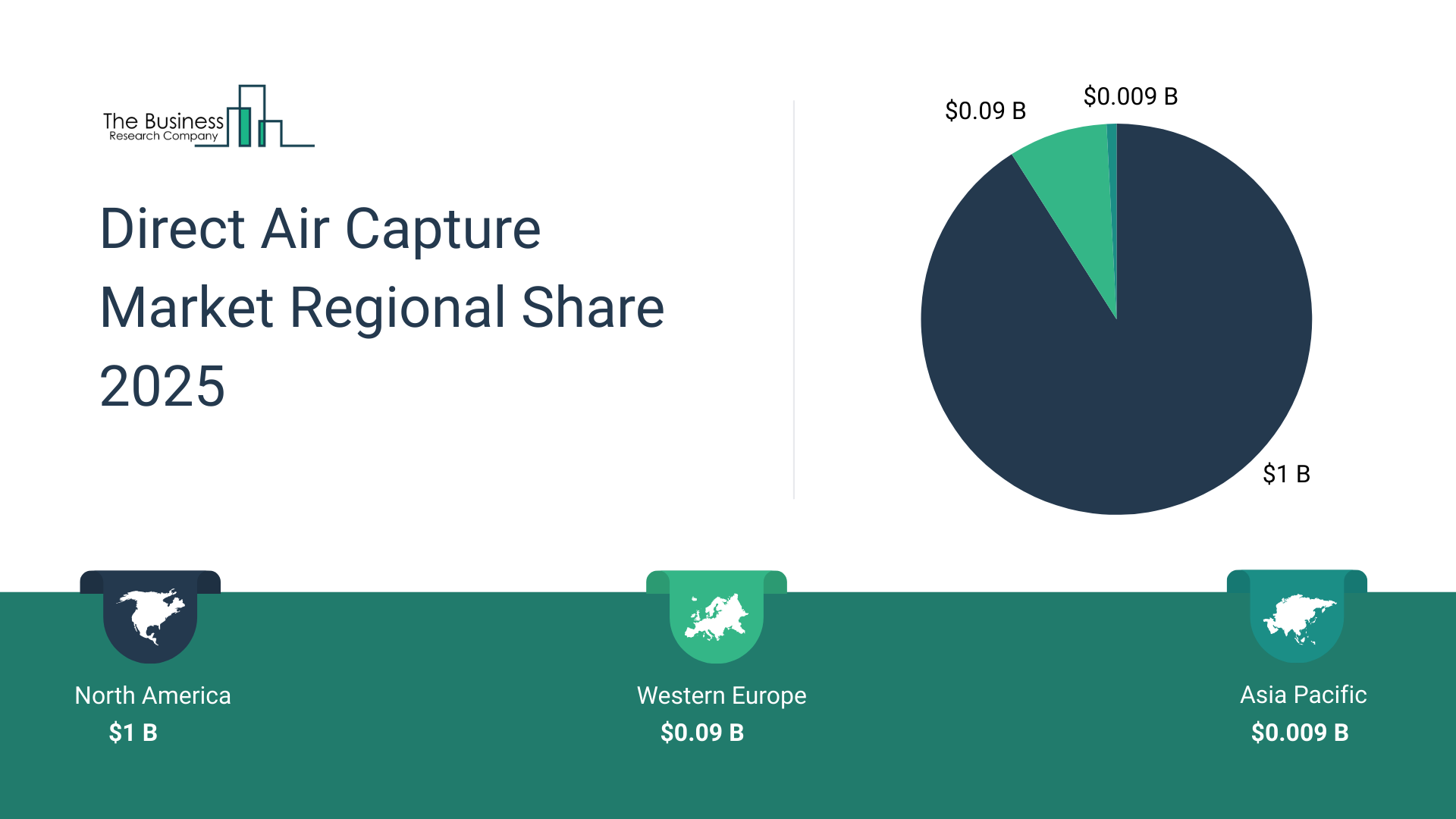
North America will be the largest region in the direct air capture market size in 2029, valued at $3,313 million. The market is expected to grow from $24 million in 2024 at a compound annual growth rate (CAGR) of 168%. The exponential growth is supported by the growing investment by venture capital and energy companies and rising merger and acquisition activity.
Which Will Be The Largest Country In The Global Direct Air Capture Market In 2029?
The USA will be the largest country in the direct air capture market in 2029, valued at $3,174 million. The market is expected to grow from $23 million in 2024 at a compound annual growth rate (CAGR) of 167%. The exponential growth can be attributed to the growing investment by venture capital and energy companies and favorable government initiatives.
Request a free sample of the Direct Air Capture Market report
https://www.thebusinessresearchcompany.com/sample_request?id=14331&type=smp
What will be Largest Segment in the Direct Air Capture Market in 2029?
The direct air capture market is segmented by product into absorption-based, adsorption-based, membrane-based and cryogenic-based. The adsorption-based market will be the largest segment of the direct air capture market segmented by product, accounting for 62% or $2,482 million of the total in 2029. The adsorption-based market will be supported by the use of solid sorbents that can be regenerated with heat or vacuum, increasing research into metal-organic frameworks (MOFs) and amine-functionalized solids, higher selectivity of CO₂ at low concentrations, flexibility in modular system design, advancements in thermal swing and pressure swing adsorption systems and growing deployment in pilot and demonstration facilities.
The direct air capture market is segmented by scale into pilot-scale, demonstration-scale and commercial-scale. The commercial-scale market will be the largest segment of the direct air capture market segmented by scale, accounting for 90% or $3,619 million of the total in 2029. The commercial-scale market will be supported by rising corporate demand for permanent carbon removals, expansion of voluntary carbon markets, strong financial backing from technology investors and oil majors, deployment of large-scale DAC plants like Climeworks’ Mammoth and Occidental’s STRATOS, regional policy incentives such as the U.S. 45Q tax credit and EU Carbon Removal Certification Framework and integration with carbon storage hubs and CO₂ pipelines.
The direct air capture market is segmented by source into electricity and heat. The electricity market will be the largest segment of the direct air capture market segmented by source, accounting for 74% or $2,953 million of the total in 2029. The electricity market will be supported by the increasing availability of low-cost renewable electricity, growing deployment of DAC plants co-located with solar and wind farms, emphasis on energy efficiency and emissions intensity of operations, development of all-electric DAC systems, decarbonization of power grids enabling net-negative operations and expansion of direct power purchase agreements (PPAs) between DAC operators and clean energy providers.
The direct air capture market is segmented by application into carbon capture and storage (CCS) and carbon capture, utilization and storage (CCUS). The carbon capture and storage (CCS) market will be the largest segment of the direct air capture market segmented by application, accounting for 88% or $3,500 million of the total in 2029. The carbon capture and storage (CCS) market will be supported by growing demand for permanent CO₂ removal solutions, availability of geological formations for long-term storage, policy mandates and compliance targets in North America and Europe, issuance of durable carbon removal credits by organizations like Verra and Puro. earth, partnerships between DAC and carbon storage developers (e.g., Carbfix) and increasing regulatory clarity on MRV (measurement, reporting and verification) standards (ERP) and user-friendly interfaces that simplify deployment for industries with limited technical expertise.
The direct air capture market is segmented by end-use into oil and gas, food and beverage, automotive, chemicals, healthcare and other end-uses. The oil and gas market will be the largest segment of the direct air capture market segmented by end-use, accounting for 43% or $1,701 million of the total in 2029. The oil and gas market will be supported by growing pressure to decarbonize upstream and downstream operations, rising investment in carbon offset and removal credits, integration of DAC with enhanced oil recovery (EOR) processes, government incentives like the U.S. 45Q tax credit for CO₂ sequestration, establishment of large-scale DAC hubs by major oil companies such as Occidental and ExxonMobil, the need to meet ESG targets and partnerships with DAC startups for long-term carbon management
What is the expected CAGR for the Direct Air Capture Market leading up to 2029?
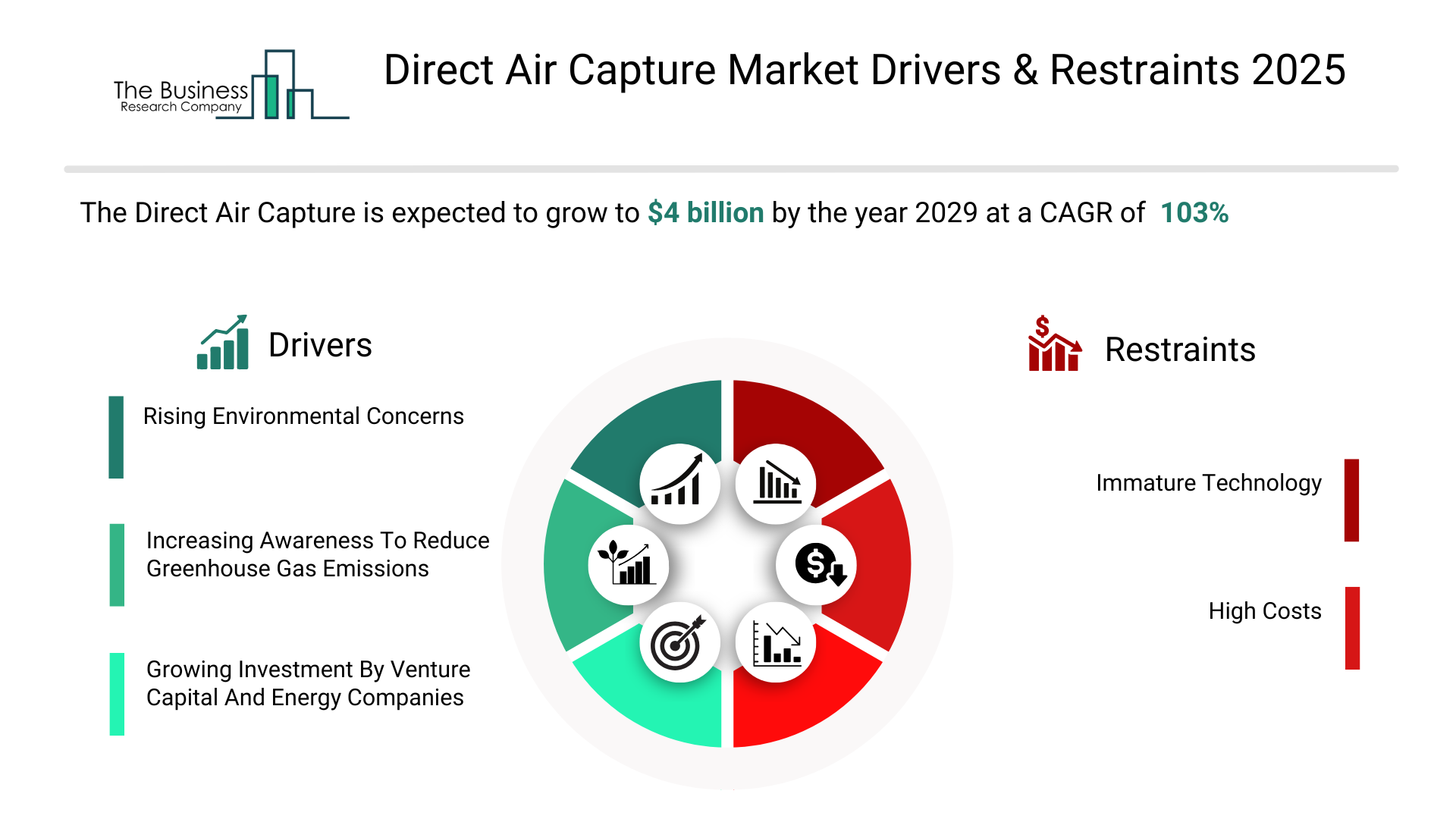
The expected CAGR for the direct air capture market leading up to 2029 is 103%.
What Will Be The Growth Driving Factors In The Global Direct Air Capture Market In The Forecast Period?
The rapid growth of the global direct air capture market leading up to 2029 will be driven by the following key factors that are expected to reshape industrial processes, sustainability strategies, and carbon management worldwide.
Rising Environmental Concerns - The rising environmental concerns will become a key driver of growth in the direct air capture market by 2029. Globally, mounting climate risks are prompting stricter emissions policies, public pressure, and corporate sustainability commitments, all of which are expanding demand for carbon removal solutions such as DAC. However, in the United States, the Trump administration’s climate stance complicates this trajectory. While the administration has rolled back many environmental regulations and publicly questioned climate science, it has paradoxically supported carbon capture technologies, including DAC, as part of its pro-industry energy agenda. Reports suggest that Trump’s government views DAC as a way to reduce emissions without limiting fossil fuel use. This selective backing may result in continued funding for carbon capture infrastructure, but without the broader climate policy framework seen in previous years. As a result, the rising environmental concerns is anticipated to contributing to annual growth in the market.
Increasing Awareness To Reduce Greenhouse Gas Emissions - The increasing awareness to reduce greenhouse gas emissions will emerge as a major factor driving the expansion of the direct air capture market by 2029. Growing climate awareness is pushing governments, companies and individuals to take urgent action on greenhouse gas reductions, driving demand for solutions like DAC. Governments are responding with stricter emissions regulations, tax incentives and inclusion of DAC in national climate strategies, creating a favorable regulatory landscape. At the same time, businesses are setting ambitious net-zero or ca, , rbon-negative targets, often requiring high-quality carbon removals to offset hard-to-abate emissions. DAC is increasingly seen as a credible, scalable option to meet these commitments. Consequently, the increasing awareness to reduce greenhouse gas emissions is projected to contributing to annual growth in the market.
Growing Investment By Venture Capital And Energy Companies - The growing investment by venture capital and energy companies will serve as a key growth catalyst for the direct air capture market by 2029. Venture capital and energy companies are instrumental in advancing DAC by providing essential early-stage funding for research, pilot projects and initial scaling. Their support enables DAC startups to move beyond the lab and begin commercial deployment, with energy firms also contributing infrastructure expertise. High-profile investments boost market credibility, attracting more institutional capital and policy attention. This visibility encourages corporate buyers to commit to long-term carbon removal contracts. As funding increases, companies can scale operations and optimize supply chains, driving cost reductions. Therefore, this growing investment by venture capital and energy companies is projected to supporting to annual growth in the market.
Growth In Demand For Hydrogen And Synthetic Fuels - The growth in demand for hydrogen and synthetic fuels will become a significant driver contributing to the growth of the direct air capture market by 2029. DAC plays a pivotal role in enabling clean synthetic fuel production by supplying a consistent source of atmospheric CO₂, essential for combining with green hydrogen to produce e-fuels. As demand for carbon-neutral fuels grows, especially in aviation, shipping and other hard-to-electrify sectors, DAC becomes critical to scaling up fuel supply without increasing emissions. The integration of DAC with green hydrogen pathways supports the production of climate-friendly alternatives like methanol and synthetic gasoline. This synergy addresses the decarbonization needs of high-energy transport sectors while creating viable routes to meet net-zero targets. Moreover, by recycling captured CO₂ into fuels, DAC contributes to a closed-loop carbon system, reinforcing circular economy goals. Consequently, the growth in demand for hydrogen and synthetic fuels is projected to contributing to annual growth in the market.
Access the detailed Direct Air Capture Market report here:
https://www.thebusinessresearchcompany.com/report/direct-air-capture-global-market-report
What Are The Key Growth Opportunities In The Direct Air Capture Market in 2029?
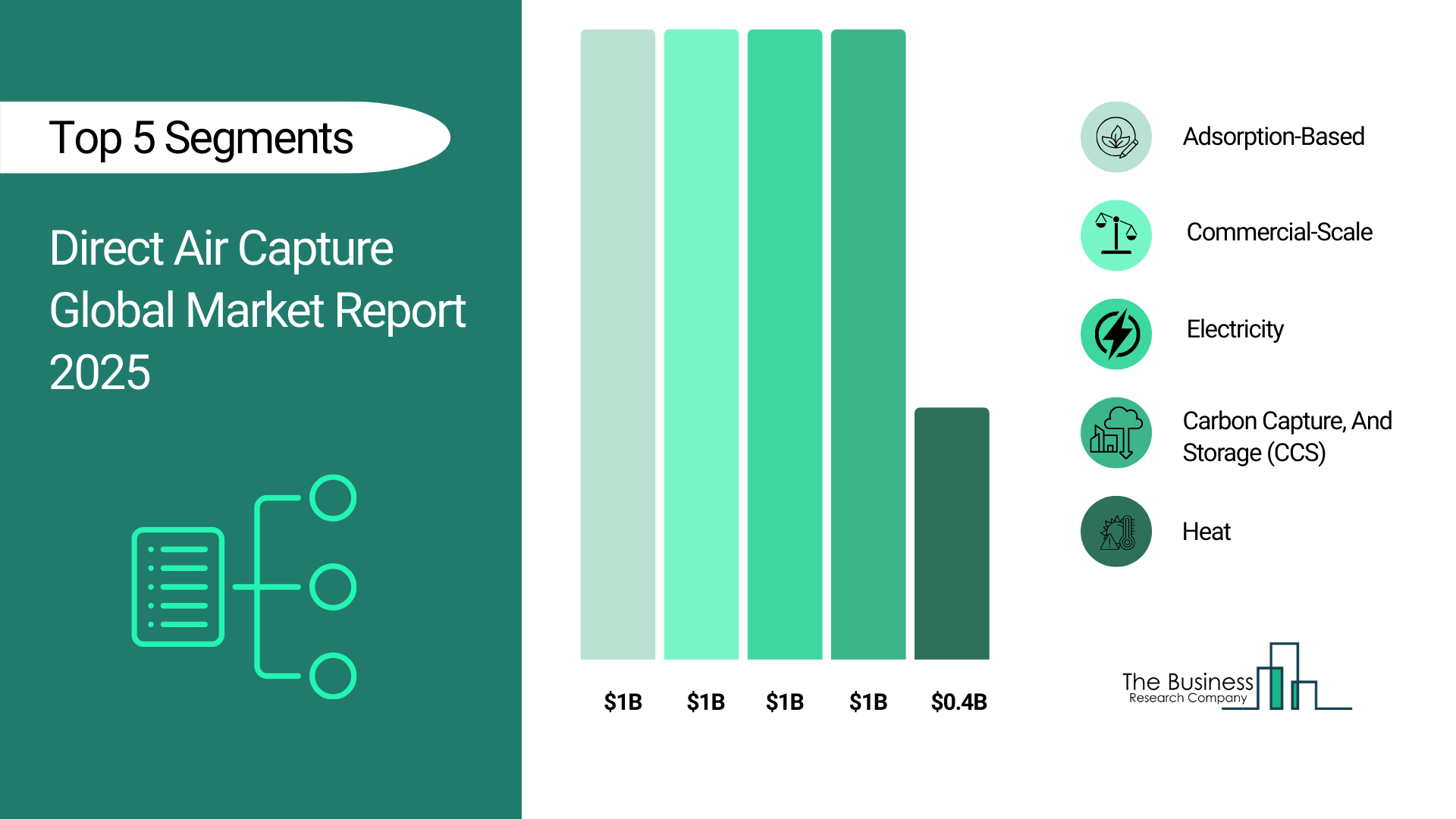
The most significant growth opportunities are anticipated in the adsorption-based direct air capture market, the commercial-scale direct air capture market, the direct air capture for electricity market, the direct air capture and storage market, and the direct air capture for oil and gas market. Collectively, these segments are projected to contribute over $14 billion in market value by 2029, driven by advances in energy-efficient capture technologies, integration with renewable power and industrial processes, supportive government policies, and growing corporate net-zero commitments. This surge reflects the accelerating adoption of direct air capture solutions that enable permanent CO₂ removal and circular carbon utilization, fueling transformative growth within the broader carbon removal and climate-tech industry.
The commercial-scale direct air capture market is projected to grow by $3,531 million, the direct air capture and storage market by $3,410 million, the direct air capture for electricity market by $2,877 million, the adsorption-based direct air capture market by $2,407 million and the direct air capture for oil and gas market by $1,659 million over the next five years from 2024 to 2029
The Business Research Company (www.thebusinessresearchcompany.com) is a leading market intelligence firm renowned for its expertise in company, market, and consumer research. We have published over 17,500 reports across 27 industries and 60+ geographies. Our research is powered by 1,500,000 datasets, extensive secondary research, and exclusive insights from interviews with industry leaders.
We provide continuous and custom research services, offering a range of specialized packages tailored to your needs, including Market Entry Research Package, Competitor Tracking Package, Supplier & Distributor Package and much more
Disclaimer: Please note that the findings, conclusions and recommendations that TBRC Business Research Pvt Ltd delivers are based on information gathered in good faith from both primary and secondary sources, whose accuracy we are not always in a position to guarantee. As such TBRC Business Research Pvt Ltd can accept no liability whatever for actions taken based on any information that may subsequently prove to be incorrect. Analysis and findings included in TBRC reports and presentations are our estimates, opinions and are not intended as statements of fact or investment guidance.
The Business Research Company
Americas +1 310-496-7795
Europe +44 7882 955267
Asia & Others +44 7882 955267 & +91 8897263534
Email: info@tbrc.info"
Oliver Guirdham
The Business Research Company
+44 7882 955267
info@tbrc.info
Visit us on social media:
LinkedIn
Facebook
X
Legal Disclaimer:
EIN Presswire provides this news content "as is" without warranty of any kind. We do not accept any responsibility or liability for the accuracy, content, images, videos, licenses, completeness, legality, or reliability of the information contained in this article. If you have any complaints or copyright issues related to this article, kindly contact the author above.
